
The Strait of Hormuz is no longer a thought experiment. A war has been under way in the region since 28 February 2026, and the IEA (22 June 2026) reports that tanker traffic through the strait has collapsed. For your household, what happens in the Gulf reaches the energy bill through the oil price.
Definition: The world's most critical oil bottleneck
The strait links the Persian Gulf with the Gulf of Oman, with Iran to the north and Oman to the south. The EIA (4 August 2017) gives its width at the narrowest point as 21 miles, and each shipping lane is only two miles wide.
According to the EIA (16 June 2025), oil flows through the strait averaged about 20 million barrels per day in 2024, the equivalent of about 20% of global petroleum liquids consumption, and 84% of the crude and condensate went to Asian markets. Only a small share can be rerouted: the EIA estimates that about 2.6 million b/d of Saudi and UAE pipeline capacity could be available to bypass the strait.
Geopolitical conflicts at Hormuz
The strait has a long record of conflict. During the 1980–1988 Iran-Iraq War both sides attacked tankers in the Gulf. In 2019 attacks on tankers in the Gulf of Oman raised US-Iran tensions. Since 28 February 2026 a war in the Middle East has cut flows from around 20 million barrels a day before the conflict to an average of 2.7 million in March, April and May (IEA, 22 June 2026).
How Gulf tensions instantly spike Brent prices
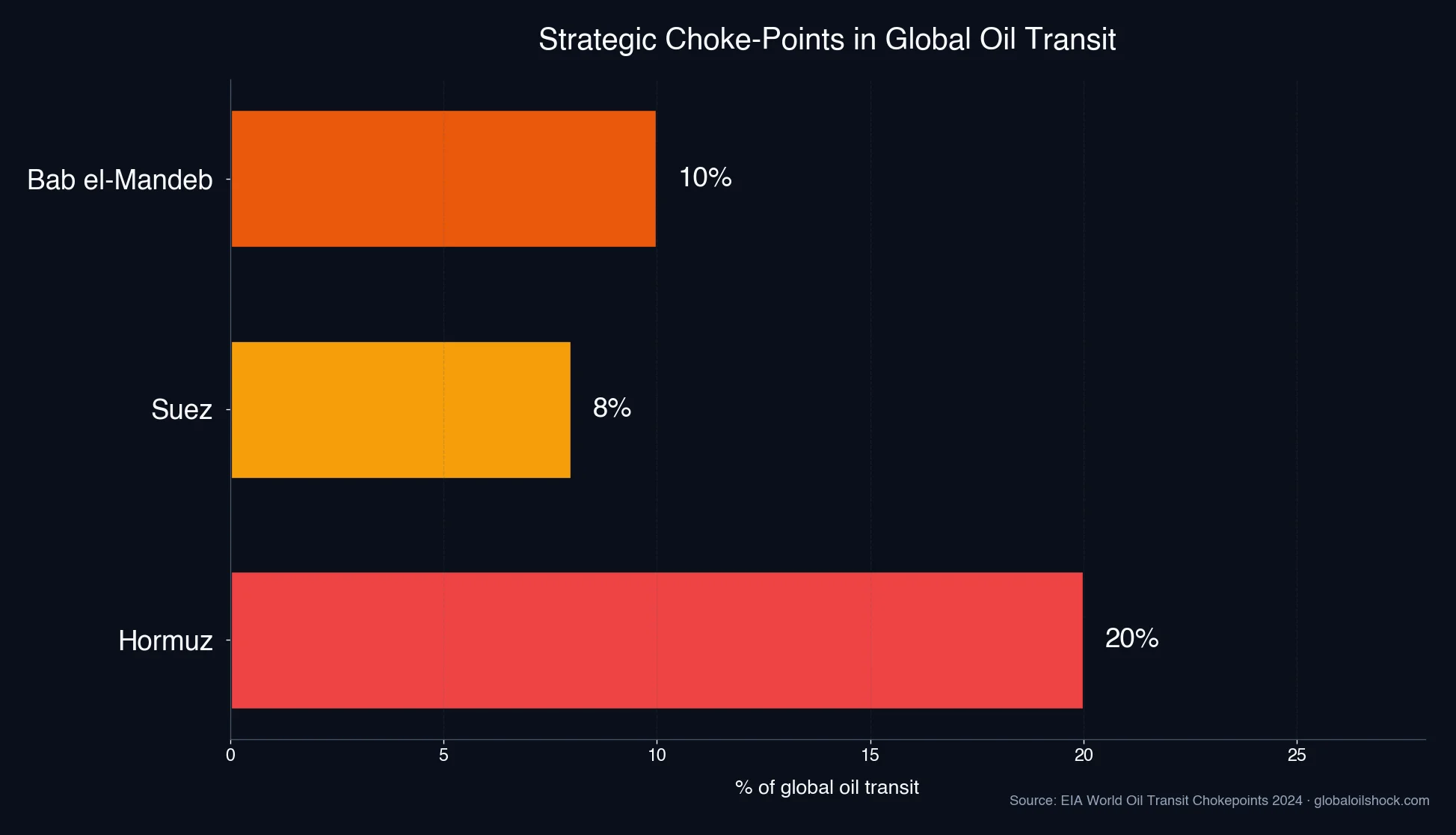
Brent is traded on futures exchanges, where news is priced in straight away. When supply that should pass through Hormuz is lost, buyers compete for the remaining barrels and the price rises. How far and for how long depends on how much oil is lost, how much can be rerouted by pipeline and whether governments release reserves, so a headline cannot be turned into a fixed price premium.
What Hormuz risk means for your household
Hormuz risk reaches you through three channels: the crude price, the prices of diesel and heating oil, which can rise further when middle distillates are scarce, and higher freight and insurance costs. The IEA (22 June 2026) notes that the collapse in tanker traffic has disrupted not only crude but also middle distillates such as diesel and jet fuel. What that means for you depends on how much you use; there is no reliable one-size figure.
Action: Reading geopolitical early signals
Check the date and source behind any figure: volume estimates for the strait vary widely, and dated IEA and EIA reports are more reliable than single ship counts. A Brent jump shows how the market reads the news, not what your supplier will charge tomorrow. News from the Gulf does not tell you when to order heating oil; your tank level and needs are a better guide. In the long run, using less oil, through insulation or a different heating system, reduces your exposure to Gulf disruptions.