
Brent Crude is more than just a grade of oil, it's the yardstick by which almost every other crude grade is measured. When news anchors mention that “the oil price” rose to 85 dollars today, they usually mean Brent. The Brent price ultimately determines what you pay at the gas pump, at the heating-oil delivery, and on your gas bill at month's end.
Definition: What is Brent Crude?
Brent Crude is a light, low-sulfur grade of crude oil from the North Sea. More precisely, Brent is a “blend”, a mixture of oil from four originally separate fields: Brent, Forties, Oseberg, and Ekofisk (BFOE for short). The physical specs: roughly 38° API gravity (a density measure; higher = lighter), 0.37 percent sulfur content. These properties make Brent a high-quality, easy-to-refine crude, ideal for producing diesel, gasoline, and heating oil with relatively low processing effort.
As a benchmark, Brent prices roughly two-thirds of globally traded crude. That means: when a tanker carries Nigerian, Libyan, or Kazakh oil, the contract price is almost always quoted as “Brent + X” or “Brent − Y” dollars per barrel. The only meaningful competitor is West Texas Intermediate (WTI), the U.S. benchmark, which dominates North American oil deals.
History and origin of the benchmark
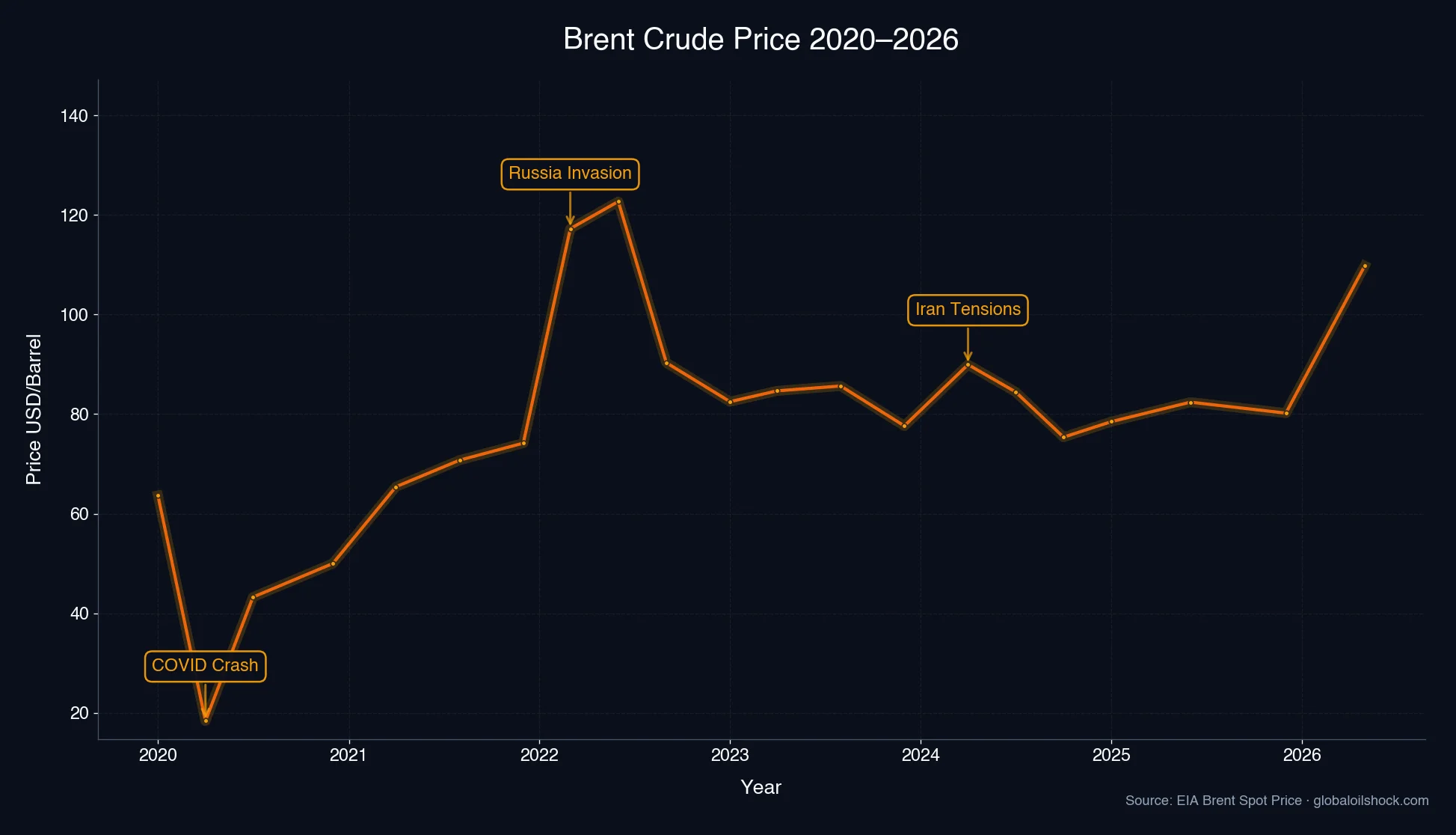
The Brent field was discovered in 1971 by Shell-Esso, roughly 186 kilometers northeast of Scotland's Shetland Islands. First deliveries flowed in 1976. From a pure production area, the region evolved into the global price benchmark with the launch of the Brent Futures contract in 1988 at the International Petroleum Exchange (today's ICE Futures Europe in London).
Four moments worth knowing:
- 1971: Brent field discovered. Named after the Brent goose (Shell convention: production fields named after birds).
- 1988: Brent Futures contract launched, first time daily, transparent price discovery.
- 2002: Expansion to BFO (adding Forties, Oseberg) due to declining Brent production.
- 2007: Ekofisk added → BFOE standard, still in use today. Since 2018 the “Dated Brent” basket has also included Troll oil to safeguard liquidity.
How the Brent price ripples through the world
When the Brent price moves in London, a cascade runs through the global energy economy:
1. Spot market and forward curve. Brent trades in two forms: as “Dated Brent” (physical delivery in the current month) and as ICE Futures contracts with delivery months up to five years out. The gap between spot and futures shows market expectations: in backwardation (spot above futures) short-term supply is tight; in contango (futures above spot) the market expects rising prices or oversupply.
2. Pass-through into end products. How long it takes for Brent to reach the pump and the retail heating-oil price is not fixed; it depends on taxes, competition and inventories. The long-term correlation Brent → heating oil sits around 0.9, meaning 90 percent of heating-oil price moves are explained by Brent alone.
3. Geopolitical reaction. Tensions in the Persian Gulf, OPEC+ quota decisions, hurricanes in the U.S. Gulf, or sabotage of an oil pipeline, all show up in Brent futures within minutes. Brent is therefore also a real-time sentiment barometer for global risk.
What Brent means for your household
Even if you never buy Brent directly, its price flows into four lines of your household budget:
- Fuel prices: Roughly 35 to 45 percent of the pump price is the Brent component. A 10-dollar Brent rise typically means 6 to 8 cents per liter more for diesel within weeks.
- Heating oil: Strongest correlation. A 3,000-liter delivery becomes about 700 to 1,000 euros more expensive when Brent moves from 80 to 120 USD.
- Electricity (indirect): Gas prices partly couple to oil, and gas is the price-setting source in many electricity markets (merit-order effect). In Germany this hit hard in 2022.
- Food inflation: Fertilizer, logistics, greenhouse heating, all carry a Brent share in the cost stack. A Brent shock therefore reaches the supermarket shelf only with a delay.
Action: Using Brent as an early-warning signal
Brent is a public, real-time price. You don't need to be a trader to use it as an early-warning system for your household finances:
- Daily watch: Read today's price against the trend of recent weeks rather than against fixed thresholds.
- Weekly trend, not daily: 2-dollar daily swings are noise. Only a 10+ USD move over two weeks is a real signal.
- Heating-oil timing: The Brent price alone does not tell you when to order; what matters is your tank level and how much you need.
With the calculator below you can simulate in 60 seconds how a Brent jump would change your concrete monthly energy costs, based on your actual consumption and location.