
A futures curve is not just a single price. It is a time series: spot price (today), 1-month contract, 3-month contract, 6-month contract, 12-month contract.
Contango vs backwardation in 2026: reading today's oil curve
On 2 September 2026 both Brent and WTI were trading in steep backwardation, the pattern where near-term barrels cost more than ones for later delivery: the front-month WTI contract stood near 90 USD/bbl while barrels for delivery in the early 2030s traded around 60 USD/bbl, and Brent for November 2026 settled at 95.26 USD/bbl against mid-60s USD pricing for contracts in the 2030s, a spread of about 25 to 30 USD/bbl (Commodity Board News, 2 September 2026). That is the textbook shape of backwardation: refiners and traders will pay up for a barrel today because they are not confident one will be available, and cheap, later.
Two forces are keeping the front of the curve elevated. First, the Strait of Hormuz remains effectively closed to normal traffic: Kpler tracked roughly 13 tankers a day transiting in early September against about 100 a day before the crisis (Al Jazeera, how much oil is going through Hormuz, 3 September 2026), and Iran's parliament speaker Ghalibaf has described "full control" of the strait with no reopening planned. See Hormuz crisis and fuel prices for the shipping data behind that squeeze. Second, US distillate inventories were running about 13% below their five-year average in early September, with refinery utilisation at 97.8% (EIA, cited 11 September 2026): when the product that is short, is short right now, near-term prices get bid up faster than far-dated ones, widening backwardation.
Heating oil shows the same signal in a single number. The NY Harbor heating oil futures contract closed at 5.10 USD/gal on 11 September 2026, up 18.5% on the month (Trading Economics), a move that tracks tight prompt supply rather than a change in long-run fundamentals. On the crude side, Brent closed at 103.98 USD/bbl on 11 September 2026, well above the EIA's own September 2026 Short-Term Energy Outlook forecast of a 91 USD/bbl average for 2026 and 74 USD/bbl for 2027 (EIA STEO, published 9 September 2026). A spot price running that far ahead of the agency's own multi-year average is itself a sign the market is pricing today's scarcity higher than tomorrow's, which is the backwardation pattern, not a specific curve reading for that date.
For anyone buying heating oil, the practical read is: backwardation shows that the market is tight right now, but it is not a forecast you can time an order on. See spot price vs futures market for how the curve is built, and the buy now or wait decision framework for turning that into a fill-up decision.
| Signal | Meaning | What to do |
|---|---|---|
| Front-month above later months (backwardation) | Traders pay a premium for oil now; near-term supply is seen as tight | Avoid delaying a needed fill-up on hopes prices fall |
| Front-month below later months (contango) | Storage is attractive; the market expects more supply later | Waiting or spreading out purchases carries less risk |
| Spot price level vs EIA's multi-year average (e.g. Brent 103.98 USD vs STEO 91/74 USD, 11 September 2026; a price-level comparison, not itself a curve reading) | Current scarcity priced well above the agency's longer-run view | Treat the current price as a near-term spike, not the new normal, when planning |
| Distillate stocks 13% below five-year average (EIA, September 2026) | Physical product tight alongside the paper market | Expect heating oil premiums to persist into peak season |
Sources for the 2026 update
- Commodity Board News, Crude oil rally steepens backwardation, 2 September 2026
- Trading Economics, Brent crude, 11 September 2026
- Trading Economics, NY Harbor heating oil futures, 11 September 2026
- EIA Short-Term Energy Outlook, September 2026
- Al Jazeera, How much oil is going through Hormuz? How data doesn't match US claims, 3 September 2026
Definition: Contango vs. Backwardation on the Price Axis
CONTANGO (upward sloping curve): The curve rises to the right. Example Brent January 2024: Spot 75 USD/bbl, 1M 76 USD, 3M 77.50 USD, 6M 78 USD, 12M 78.50 USD. Prices increase over time. That is contango. Economically this means: storage is attractive. A speculator can buy oil today (75 USD), store it (costs 0.50–1.50 USD/month), and sell it in 6 months for 78 USD. Profit: 2–3 USD minus storage = 0.50–2 USD/bbl, a profitable trade.
BACKWARDATION (downward sloping curve): The curve falls to the right. Example Brent October 2022 (post-Russia invasion): Spot 95 USD/bbl, 1M 92 USD, 3M 88 USD, 6M 83 USD, 12M 75 USD. Prices decline over time. That is backwardation. Economically this means: immediate scarcity. The spot price is high because oil is needed NOW. Future oil is cheaper because the shortage is expected to ease. Storage is NOT profitable, you pay 95 USD, store it, and get less later. Buyers pay a scarcity premium TODAY.
Historical Examples: 2020 Super-Contango, 2022 Backwardation
April 2020, COVID crash, super-contango record. Lockdown: refineries cut runs, storage full, demand in freefall. Massive oversupply. WTI front-month (May): −37 USD (yes, NEGATIVE, sellers paid to offload oil). WTI 12-month contract: +20 USD. Spread: 57 USD per barrel! Result: speculators chartered oil tankers (VLCCs), bought oil at −37 USD, loaded it, anchored the tankers offshore, and waited. After 4–6 months they sold the oil at higher prices. Floating storage became an arbitrage play. Heating oil side: prices CRASHED April–May 2020. Super-contango signaled oversupply and falling prices.
October–December 2022, Russia invasion, deep backwardation. Europe banned Russian oil. Brent supply tight, especially front-end. Strong physical demand. Brent spot: 95 USD/bbl, Brent 1M: 90 USD, Brent 6M: 80 USD. Front-6M spread: −15 USD (deep backwardation). Result: refineries ran FLAT OUT. Storage was NOT profitable. Heating oil prices SOARED due to spot premium.
Why Curve Shape Matters, Storage Economics
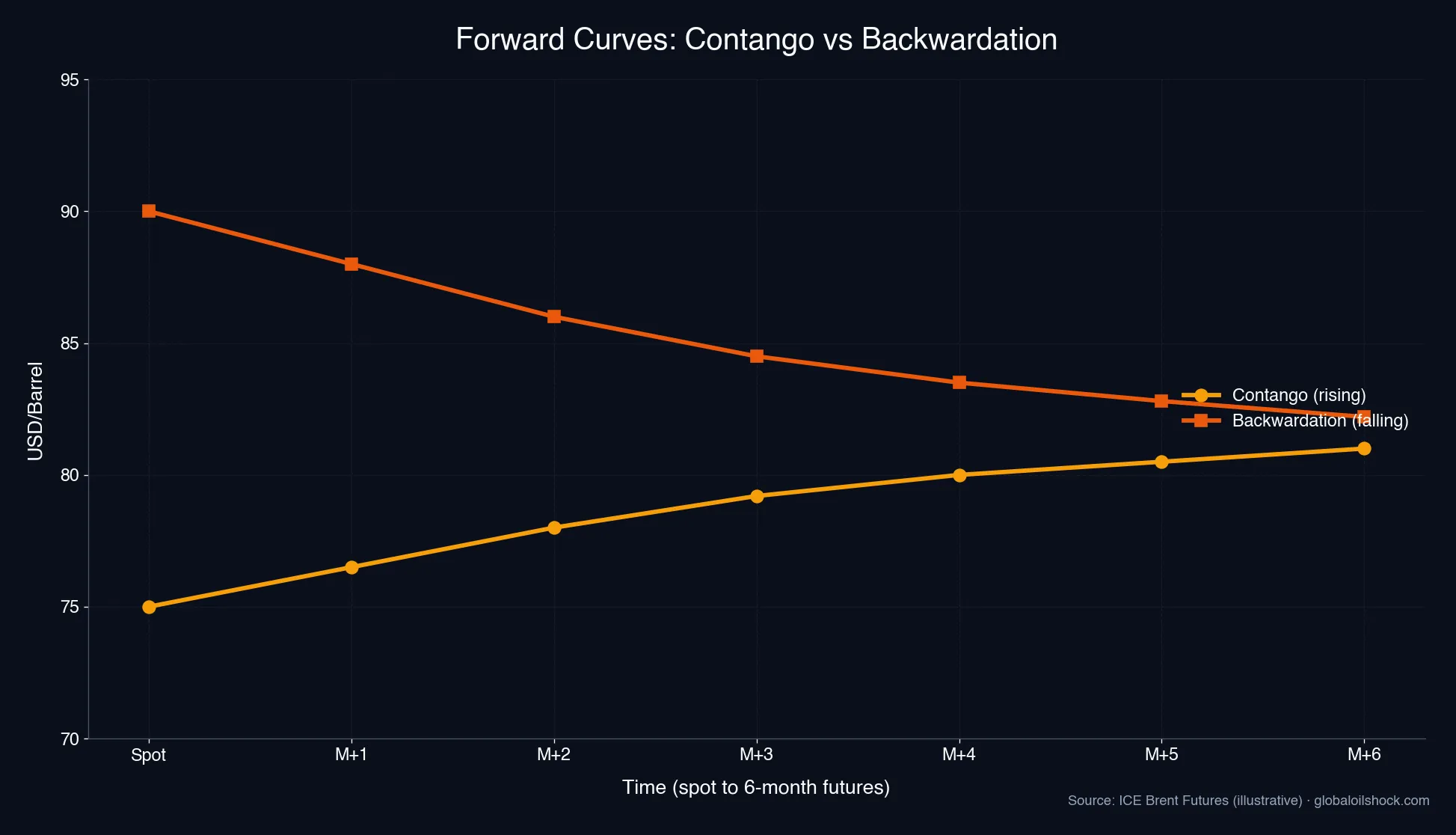
Curve shape depends on storage costs: 0.50–2 USD/bbl/month. In contango the spread MUST exceed storage costs for arbitrage to be profitable. In backwardation there is NO spread to offset. That is the signal: oil is TIGHT RIGHT NOW.