Definition and Origins
The sanctions shadow is not a new asset class or technical instrument. It is a simple phenomenon: markets ignore illegal prohibitions.
When the West imposes sanctions on oil-exporting nations (Russia, Iran, Venezuela) and forbids them to sell oil, a market emerges anyway, not on exchanges (WTI/Brent), but in the grey zone. Buyers (India, China, allies) pay, but less. Sellers (sanctioned nations) accept a discount, better than zero.
This is the core: Sanctions shadow = illegal oil at discounted prices, transported by untraceable ships, to invisible buyers.
Figures for 2024: The sanctions shadow moves ~10–12 million barrels per day (mbpd) globally. That is roughly 10–12% of global oil consumption of ~100 mbpd. This is not a niche, it is significant.
How the Sanctions Shadow Emerged: Russia, Iran, Venezuela
Russia (Feb 2022 – today)
After the Ukraine war, the West imposes sanctions on Russian oil. The intention was to cut Putin's revenues. But: oil is a global business. Russia cannot simply stop producing. It must sell those millions of barrels somewhere.
Solution: New buyers. India doubled Russian oil purchases in 2022–2023. China remains a loyal buyer. But both pay less, because the oil is «hot».
Price effect: Russian Urals crude trades at a 10–25 USD/barrel discount to Brent. At 85 USD/barrel Brent = 60–75 USD for Urals. That is the sanctions discount.
How is the price cap evaded? The USA and G7 set a price cap of 60 USD/barrel on Russian oil in December 2022. The idea: do not sell oil above 60, then financing stops.
Trick: The shadow fleet buys the oil at 55–60 USD, below the cap's radar. Or: the oil is relabeled in Dubai as «Malaysian» or «Omani» crude and sold above 60.
Efficiency: The cap is routinely circumvented. Russia exports today ~3–3.5 mbpd via shadow channels, but earns LESS than before (2021: 3.5–4 mbpd at 100+ USD = 350–400 billion USD/year; 2024: 3 mbpd at 65–75 USD = 70–80 billion USD/year). Sanctions work, but imperfectly.
Iran (since 1979, Escalation 2018)
Iran has been under sanctions since the 1979 revolution. No oil exports through official channels (USA blocks).
2015: JCPOA (Iran nuclear deal). Iran can export 1.5+ mbpd. Brief hope.
2018: USA withdraws from JCPOA. New sanctions. Iran's oil exports collapse from 2.5 mbpd (2017) to below 0.5 mbpd (2019). This is sanctions blockade in pure form.
Today: Iran sells oil covertly through shadow channels. Destination: China (90%). Price: 20–30 USD/barrel below Brent. Volume: ~0.5–0.8 mbpd. For Iran, this is existential (state budget depends on it), but the price is catastrophic.
Shadow-fleet transport: Tankers are sent «dark» (AIS transponder switched off), meet at night in international waters, conduct ship-to-ship transfers (STS). The receiving tanker then needs only a cheap flag-of-convenience certificate (e.g., Panama, Bermuda) and can reappear posing as a legitimate oil carrier.
Venezuela (2019 – today)
Venezuela: world's largest oil reserves (~300 mbpd), but state collapse, election fraud, technical decay (refineries broken). After Maduro's rigged 2018 election, the USA imposes sanctions.
Effect: Oil exports plummet from 2.3 mbpd (2015) to below 0.3 mbpd (2023). Classic sanctions failure: goal was regime change, outcome is humanitarian disaster.
2023: Small opening. USA licenses Chevron to re-enter Venezuela (strategic reason: China must not totally control Venezuela). But volume remains tiny ~0.5 mbpd.
Shadow export: Venezuela sells the remainder to small Chinese and Indian buyers, at extreme discounts (30–40 USD/barrel, because the oil is extra-heavy and technically difficult to refine). This is not the classic sanctions shadow (more like global isolation), but belongs to the same grey economy.
Mechanics: Shadow Fleets, Relabeling, Price-Cap Tricks
The Shadow Fleet
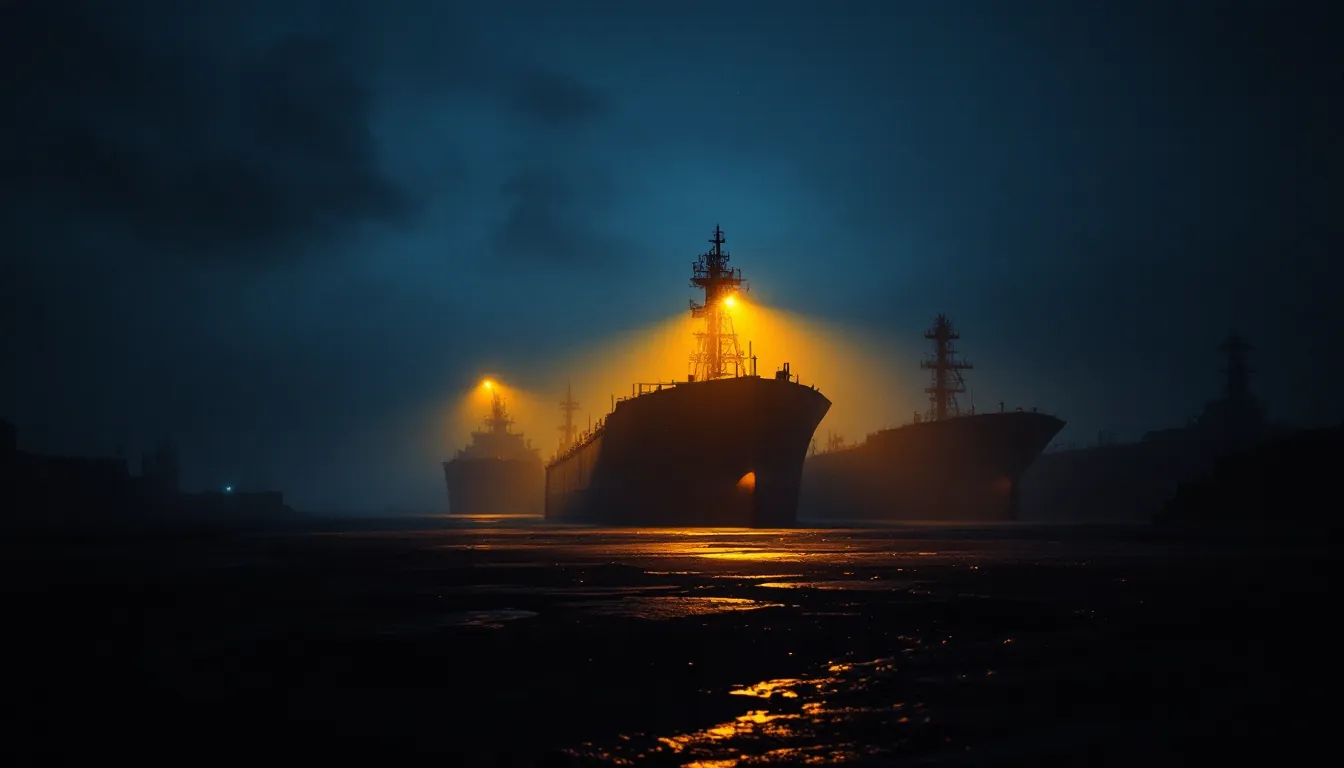
Size: ~600 tankers, averaging 20+ years old. This is a quarter to a third of the global tanker fleet. These ships were originally built for legitimate oil trade but are now underground-economy assets.
Flags: Panama, Marshall Islands, Liberia, cheap-flag countries with no regulation or oversight. A single Panama tanker gets a new certificate in 48 hours for a few thousand USD. No questions asked.
AIS spoofing: Modern tankers have an AIS transponder (Automatic Identification System) that broadcasts: «I am tanker XYZ, length 250m, position 35.5° N, 54.2° E.» Coast guards and satellites track this.
Trick: A shadow tanker switches off the AIS, runs dark. Or: broadcasts false position (claims «I'm in the Suez,» but is in the Strait of Hormuz). Or: clones the AIS of a legitimate ship (identical number, fake position). Satellite imagery has learned these light-dark patterns, but it's a cat-and-mouse game.
Ship-to-Ship (STS) Transfer: Two tankers meet in international waters (e.g., Mediterranean, Persian Gulf, South China Sea). A Russian/Iranian production tanker sits there. A shadow tanker anchors alongside. With hoses, oil is pumped (takes hours). Then: the shadow tanker departs with a new flag, new ID, new destination. Origin invisible.
Document forgery: Oil certificates claim «this crude comes from Malaysia» or «Oman,» not Russia/Iran. This is simple to forge (shell companies in Dubai/Singapore are notorious for it). Buyers pay, knowing (or ignoring) the true origin.
Relabeling and Laundering
Physically: Russian Urals crude has a characteristic sulfur content (~1.3%), API gravity, color. This can be verified in lab tests.
In practice: The oil is blended. A shadow tanker takes 50,000 tonnes of Urals. Blends it with 50,000 tonnes of genuine Omani crude (purchased via broker, legally). The blend has average properties. Certificate now says «Blend: 50% Oman, 50% other sources», technically false, but plausible.
Or: The oil is partially processed at a refinery (into heavy fuel oil), then re-exported under a new label. Primary origin is obscured.
Efficiency: Precisely tracking where 0.5 mbpd of oil per day originates is impossible. There are ~40–50 major ports globally, and a thousand tanker movements per day. Intelligence agencies use satellites, AIS tracking, informants, catch maybe 30–50% of shadow movements. The rest runs undetected.
Price-Cap Mechanics and Workarounds
December 2022: USA/G7 decree: «No one shall buy Russian oil above 60 USD/bbl.» Idea: The oil is not banned (ships, insurance, financing can still help), but only below a price cap. So some Russian oil stays on the market (no supply shock), but Russia earns less.
Workaround 1, Over-invoice: Buyer pays shadow-tanker owner 50 USD/bbl «officially» (under radar). In parallel deal, buyer pays private broker an extra 15 USD via untraceable channels (crypto, hawala, etc.). Total 65 USD, Russia effectively gets above 60, but no one can prove it.
Workaround 2, Blending: Russian oil is blended with oil derivatives (gasoil, etc.) before sale. The blend is «not crude anymore,» so the 60-USD cap does not apply (cap is for crude). The buyer can separate the blend later. Effect: no cap.
Workaround 3, Non-USD settlement: The cap says «44.10 USD/bbl maximum.» But: the sale runs in euros, yuan, rubles. The exchange rate is malleable. «44.10 USD» on paper = 55 USD effective in rubles. Technically legal, factually a circumvention.
Reality 2024: The price cap lies de-facto at 65–75 USD/bbl. Not 60. Sanctions work, discount versus 2021 is real, but they are not airtight.
What does this mean for my heating oil bill?
The sanctions shadow splits the oil market into two classes.
Class 1, Legitimate oil: Brent (Western Europe), WTI (USA), some Urals (Russia on open market, rare), other OPEC. These are exchange-traded. Price is transparent, available 24/7. These are ~88–90 mbpd worldwide.
Class 2, Shadow oil: Russian Urals via shadow channels, Iranian crude, Venezuelan oil. These are NOT exchange-traded. Price is OTC (over-the-counter), private deals between countries/corporations. Only intelligence agencies and brokers know the true price.
The problem: The Brent price you see on the exchange (say, 85 USD) is a phantom. It is the price for non-sanctioned oil. When 10% of world oil supply buys shadow oil at 60–70 USD, the true marginal price is not 85, but 80–82.
This does not immediately affect YOUR heating oil bill, your German heating-oil supplier buys on the Brent market. But: the Brent price is dampened by the shadow market. Without shadow oil, Brent might cost 95–100 USD in 2024 (due to Russia loss). With shadow, it stays at 85.
So: The sanctions shadow keeps your heating oil bill ~15% lower than it would be without shadow supply. That is an indirect gift to European consumers.
But it is also a risk: If the West tightens sanctions (e.g., lowers the price cap to 40 USD), or if shadow-fleet capacity collapses (aging), then shadow oil disappears. Supply = 88 mbpd instead of 98. Brent shoots to 120–150. Your heating oil bill doubles in months.
Risks and Outlook
Scenario 1: Status quo
Sanctions remain as today, shadow fleet continues aging but operating. Shadow oil stays at ~10 mbpd. Brent stays at 80–90 USD. Your heating oil bill does not change fundamentally.
Probability: 40%. This is the baseline.
Scenario 2: Sanctions escalation
USA/EU tighten sanctions: price cap drops to 40 USD/bbl. Insurance embargo against shadow fleets is enforced (hard, but possible). Tanker replacement construction is blocked.
Effect: Shadow oil collapses from 10 mbpd to 3–5 mbpd in 2–3 years. Russian exports crash. Brent shoots to 120–150 USD. Heating oil bill rises 40–60% in 2026–2027.
Probability: 25–30%. This would be a geopolitical shock.
Scenario 3: Sanctions negotiation
Ukraine war ends, new administration, USA and Russia reach a deal: «we lift the cap, you do not increase oil output.» Or: new administration has different priorities.
Effect: Shadow oil becomes grey oil becomes light oil. Russia sells 3–4 mbpd openly again (but at price-cap or without cap). Brent drops to 70–75. Heating oil bill drops 10–15%.
Probability: 25–30%. Long-term, negotiation is likely.
Geopolitical implication
The sanctions shadow is a symptom: sanctions work partially, not totally. Markets ignore prohibitions when profit incentives are high. This applies to oil, chips, weapons, money. Absolute blockades require global coordination, and that is fractured in 2024 (nations in the South/East ignore Western sanctions).
For you: The sanctions shadow is a risk reservoir. It keeps oil prices down, but the stability is artificial. A geopolitical shock (war escalation, ship sinking in the Persian Gulf, etc.) could collapse the shadow fleet and make heating oil 50% more expensive.