
December 1971: US President Nixon ends dollar gold backing. The dollar becomes a fiat currency with no precious-metal foundation. The Bretton-Woods system collapses. Big question: Why should anyone hold dollars if they can't be exchanged for gold?
October 1973: Yom Kippur War. Saudi Arabia and OPEC impose oil embargo on USA and Western Europe. Oil prices quadruple in months. Oil-exporting nations suddenly earn billions in USD. But: They can't spend it all domestically, supply chains are short, US weapons deals are expensive.
1974: Secret talks USA–Saudi Arabia. The offer: Saudi Arabia promises to
- Invoice oil EXCLUSIVELY in USD (not in other currencies)
- Invest surplus USD in US Treasury Bonds
In return: USA guarantees military support + security umbrella against rivals like Iran.
Result: The petrodollar is born. A global currency ecosystem designed to last 50 years.
Definition: The oil-money system
The petrodollar is a vicious circle of three components:
1. USD invoicing: OPEC commits to selling crude oil worldwide ONLY in US dollars. Not in euros, yen, or other currencies. This forces all oil buyers to acquire dollars.
2. Recycling: Saudi Arabia and other petrostate economies receive billions of dollars annually. They cannot spend it all domestically. Instead, they purchase US Treasury Bonds. This is like a loan to the USA: Saudi finances US deficits.
3. Reserve anchor: Because every nation needs oil and oil can only be obtained in USD, EVERY central bank must hold USD in reserves. The dollar becomes the de-facto global reserve currency, not because of gold, but because of oil.
Effect: The US dollar remains strong. The USA can refinance its debt forever (because oil nations buy US Treasuries). An elegant, stable system, as long as OPEC and USA follow the rules.
History: Nixon Shock to Saudi Deal 1974
1944–1971: Bretton Woods era. The dollar is pegged to gold (1 USD = 1/35 ounce gold). The system works for 27 years, but it has a flaw: once a nation accumulates enough dollars, it can redeem gold. The USA continuously loses gold to Western Europe and Japan.
August 1971: Nixon Shock. President Nixon declares: «The dollar is NO LONGER convertible to gold. Period.» The gold standard implodes overnight. British pound, yen, euro precursors wobble. Chaos risk.
1972–1973: Search for stability. Economists and diplomats seek a new currency anchor. Proposals: commodity basket? IMF Special Drawing Rights (SDR)? Gold remains conceptually attractive, but impractical.
October 1973: Yom Kippur War + oil embargo. Saudi Arabia and OPEC use oil as a weapon. Oil prices quadruple in 4 months: 2.90 USD → 11.65 USD per barrel. Western nations are vulnerable. Inflation explodes. USA realizes: whoever controls oil, controls the world.
December 1973 – 1974: Saudi–USA secret talks. Henry Kissinger (US Secretary of State) and Saudi princes negotiate. Kissinger's pitch: if oil stays in dollars, world economy stabilizes. Saudi gets weapons and security. Deal struck. The petrodollar becomes official doctrine.
1974+: Expansion. Other OPEC nations (Iraq, Kuwait, UAE, etc.) follow Saudi Arabia. The dollar becomes the oil currency. All 200+ nations need dollars for oil purchases. The USA benefits: lower interest rates, cheap oil in home currency, record Treasury demand. 50 years of stability, almost.
The petrodollar mechanism: Recycling & Reserve Anchor
How does the petrodollar work in detail?
Step 1: Oil sale. Saudi Arabia pumps 10 million barrels of oil per day (2024). Price: currently ~85 USD/barrel. Daily revenue: 850 million USD. Annual revenue: ~310 billion USD. This is PETRODOLLAR income.
Step 2: Recycling challenge. Saudi cannot spend 310 billion USD domestically. Population: 35 million people. Per capita: 8,900 USD/year from oil income. Palace, military, infrastructure consume perhaps 100 billion USD/year. Rest: SURPLUS.
Step 3: Treasury purchase. Saudi invests 150+ billion USD in US Treasury Bonds. Current yield: 4–5% per year. Saudi earns interest. USA gets cheap money for national deficits. Oil revenues are converted into US debt-financing.
Step 4: Reserve anchor. Because OPEC nations hold most of their dollars in Treasuries (not gold, not rupees), and because every nation needs oil, every central bank in the world holds USD in reserves. Example: German Bundesbank holds ~45 billion USD in reserves. Japan holds 130 billion USD. Why? Because oil can only be bought with dollars. So every nation must maintain a dollar buffer.
Effect: Perpetual motion machine. As long as oil is traded in dollars and oil nations hold dollars in Treasuries, the dollar remains powerful and US Treasuries are in demand. This is the core of the petrodollar system: oil dominance = dollar dominance = Treasury demand = cheap US financing.
Consequence for your heating oil bill and wallet
For you as a household buyer of heating oil:
The petrodollar determines how expensive heating oil is in EUROS.
Example: Brent crude costs 85 USD/barrel. In Germany, you buy heating oil from a local vendor who prices in EUROS. The price is calculated as follows:
- Brent price: 85 USD/barrel → 0.60 USD/liter (standard conversion)
- EUR/USD exchange rate: e.g., 1 EUR = 1.10 USD
- Heating oil price in EUR: 0.60 USD/L ÷ 1.10 = 0.545 EUR/L (commodity only, no margin)
If the dollar weakens (e.g., 1 EUR = 1.20 USD): The same Brent at 85 USD becomes cheaper in euro: 0.60 USD ÷ 1.20 = 0.50 EUR/L (if USD weakens, heating oil is cheaper in EUR for you).
The rule of thumb: USD weakness helps you (heating oil cheaper in EUR). USD strength hurts you (heating oil more expensive in EUR). This is the petrodollar implication for your wallet.
Geopolitical risk: Dedollarisation 2024+
The petrodollar system is shaking since 2014.
Trigger 1 (2014): Russia. After the Crimea annexation, the USA imposes sanctions. Russia can no longer trade in USD. Russia turns to China, direct ruble-yuan trades for oil and gas. First cracks in the petrodollar monopoly.
Trigger 2 (2018): China. Shanghai opens an oil futures market in YUAN (not dollars). The petroyuan is born. But: small, thinly traded, not yet massively adopted.
Trigger 3 (2023): Saudi Arabia. After US sanctions against Iran, Saudi opens to Iran. December 2023: China brokers Iran–Saudi peace deal. March 2024: Saudi accepts YUAN payments for the first time for Chinese oil purchases. This is HISTORIC, a crack in the 50-year petrodollar pact.
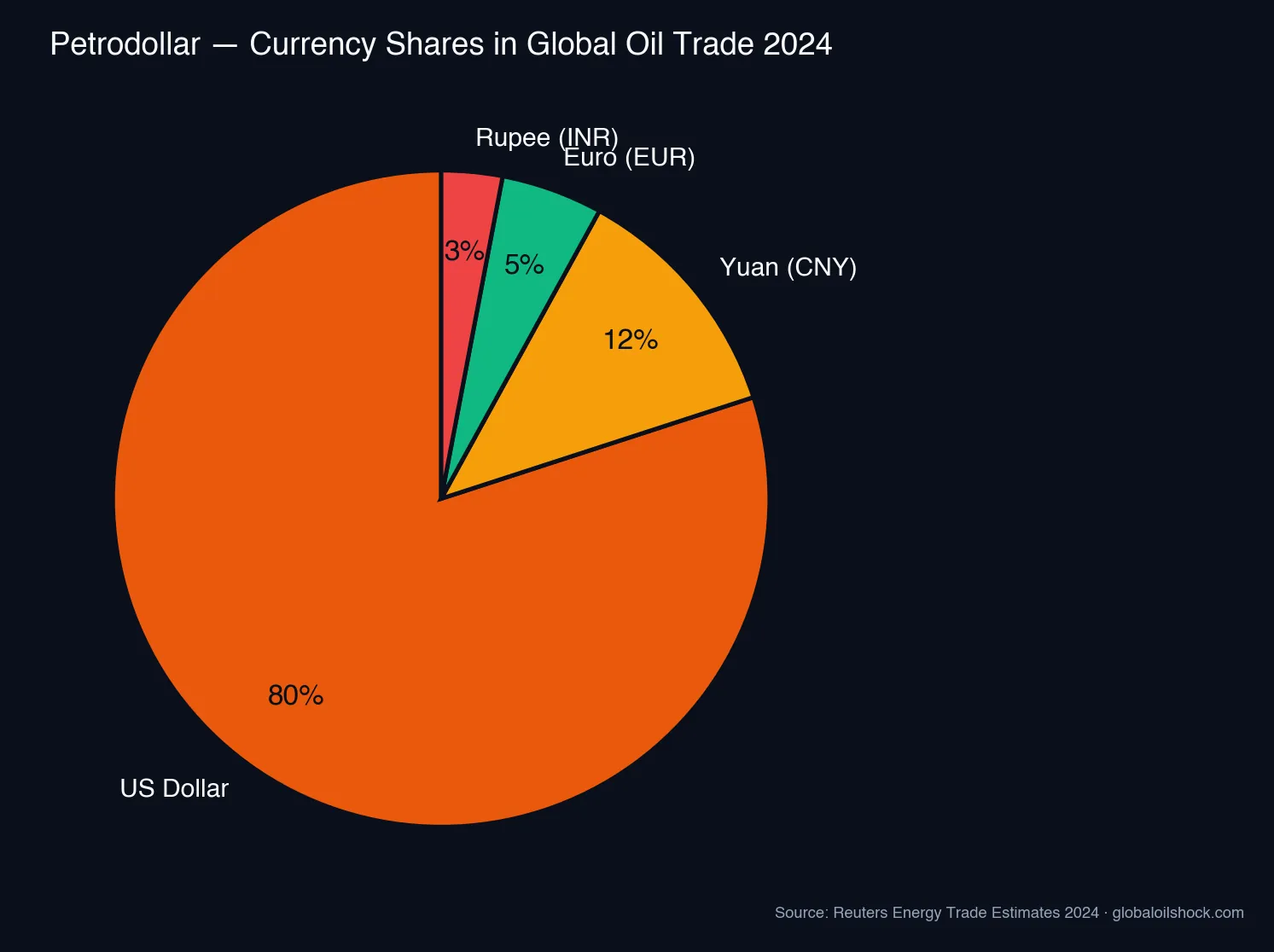
Reality of dedollarisation (2024):
- Yuan share: <5% of global oil trade (petrodollar >80%)
- Ruble share: ~15% (Russia + India + some BRICS)
- EUR share: ~5%
The petrodollar has NOT collapsed. But it is eroding.
What does dedollarisation mean for you?
- Long-term: If oil is increasingly traded in yuan, rubles, or multi-currency baskets, the dollar faces less forced demand. The dollar could weaken, meaning heating oil more expensive in euros.
- For the USA: Cheaper Treasury financing would end. That means higher interest rates for the USA and budget cuts.
- Geopolitics: A weakening petrodollar reduces US soft power (economic influence via dollar dominance), that's why the USA battles China and Russia.
Forecast to 2030: The petrodollar won't disappear, but multi-currency systems will strengthen. For European households: EUR–USD exchange volatility will increase, heating-oil prices less predictable.