1. What happened this week
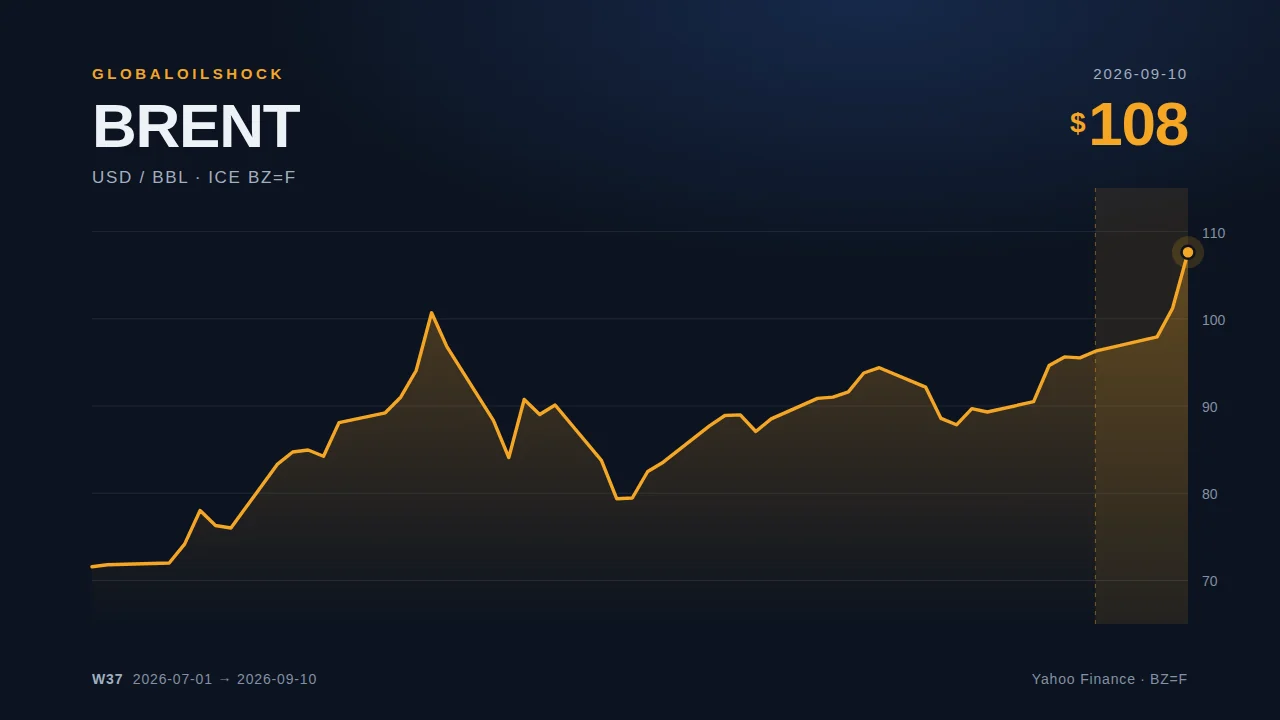
Little moved in the first half of the week. The futures contract on Brent closed at USD 96.28 on 4 September, barely changed from the day before (Yahoo Finance, BZ=F, daily close).
On 7 September, citing industry sources, OilPrice.com reported that the Aramco refinery at Jizan in the south west of Saudi Arabia had been attacked for the third time in two months, and that no export cargo had left the port in August. Saudi Arabia did not confirm this, and the Houthis had claimed earlier attacks on Jizan for themselves (OilPrice.com, 7 September 2026).
On 9 September Brent closed at USD 101.21, the first close above USD 100 since 23 July 2026.
On 10 September the Houthis took the Red Sea port city of Mokha, by several accounts their furthest advance on the ground in years (Al Jazeera, 10 September 2026; UPI, 10 September 2026). The futures contract rose 6.3 percent that same day, to USD 107.63.
2. The move above USD 100: what sits behind it
Over the week the contract went from USD 95.52 on 3 September to USD 107.63 on 10 September, a gain of 12.7 percent. It did not get there evenly. Up to 8 September the price barely moved, then 3.4 percent came on 9 September and another 6.3 percent on 10 September.
A path of that shape argues against a slow tightening of supply and in favour of a risk being repriced. No production site was reported lost between 8 and 10 September. What was reported was another hit at Jizan and the fall of Mokha. The market has not priced in less oil, then, but a less certain route for it.
The distance between the futures market and the spot market grew wider still in the weeks that followed. The short version: a futures contract settles oil due in a few months, while the spot market prices the barrels that are moving now.
3. Mokha and Jizan: why this week on the Red Sea counts
Mokha lies on the Yemeni coast, north of the narrowest point of Bab el-Mandeb. Holding the port means holding a base directly on the shipping lane. No formal closure of the strait came with it, and no attack on a merchant ship in the strait was reported this week.
Jizan lies further north, on the Saudi side of the Red Sea. According to the report of 7 September, the refinery there dispatched no export cargo in August. That is not confirmed. Saudi Arabia has said little about damage to its installations since the spring, and claims made by the attacking side cannot be checked from outside. We have therefore left the classification where it was, for as long as one unconfirmed source is all there is.
Taken together the two reports form the pattern that has shaped the Red Sea since the summer. It is not a closure. It is a growing number of places at which a ship or an installation can be hit. That shows up less in the oil price than in the war risk premium underwriters charge for these voyages.
4. 514 ships: what a jam in the Gulf means
Kpler counted 514 vessels stuck in the Persian Gulf on 10 September. None of them has been seized. They simply cannot get out on terms that make commercial sense: the Strait of Hormuz has been effectively shut to free merchant traffic since 11 July, and what remains runs in convoys.
A ship that sits still costs twice over. It earns nothing, and it is absent somewhere else. That is why freight rates climb worldwide and not only on the route in question. A supertanker chartered from the Gulf to China cost around USD 704,000 a day in the previous week, where the figure on 5 September 2025 had been USD 53,783 (Baltic Exchange, route TD3C).
No oil price carries those costs. They appear only once the oil arrives, as part of what a refinery in Europe pays for its raw material.
5. What this means for households in Europe
Every one of the four countries we follow paid more this week. Heating oil in Germany cost EUR 1,520.90 per 1,000 litres on 7 September, against EUR 1,401.80 a week earlier. Austria stood at EUR 1,710.50 (up 6.4 percent), France at EUR 1,792.50 (up 7.2 percent) and Spain at EUR 1,396.20 (up 5.6 percent). All figures from the EU Oil Bulletin, as of 7 September 2026.
Set beside the oil price, that shows how the pass through actually works. Brent gained 12.7 percent in the same week, the German heating oil price 8.5 percent. Part of the difference is tax and levies, charged as a fixed amount per litre, which damps any percentage move. Part of it is timing: the Bulletin records the position on Monday, while the jump on the futures market fell on Wednesday and Thursday. It reaches this statistic only in the following week.
On an order of 3,000 litres, the difference between 31 August and 7 September comes to around EUR 357. The weekly figures by country are on our heating oil price map, and the calculator on the home page works out what they mean for one particular household.