1. What happened this week
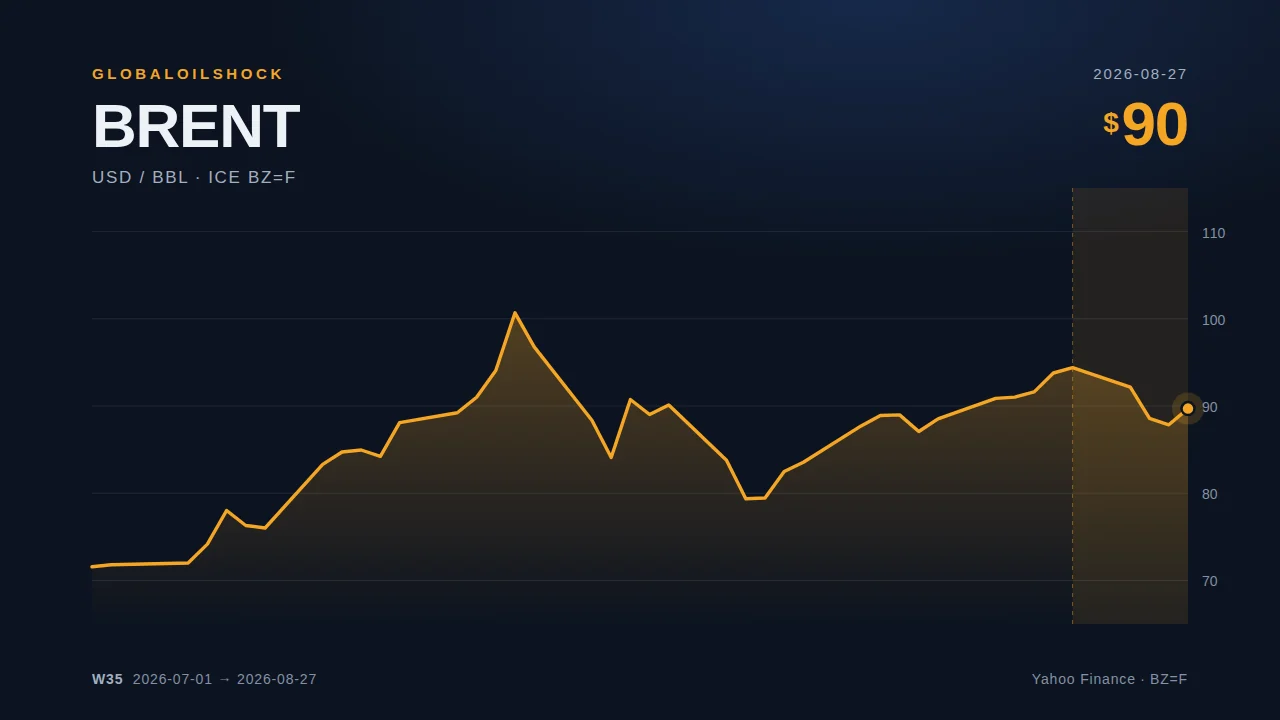
The high point of the week came first. On 21 August the futures contract on Brent closed at USD 94.39. It gave ground after that: USD 92.17 on 24 August, USD 88.58 on the 25th and USD 87.84 on the 26th. The close on 27 August was USD 89.70 (Yahoo Finance, BZ=F, daily close).
That same 27 August brought the news that mattered more. The Iraqi marketing company SOMO offered Basra crude for loading outside the Strait of Hormuz, in part by transfer from ship to ship off the coast of Oman. It was the first offer of its kind since the war began (Bloomberg, 27 August 2026; Zawya, 27 August 2026).
The AXS Marine weekly report for this week carried war risk premiums of 7.5 to 10 percent of the vessel's value for high risk voyages. Around 0.25 percent was the usual figure before the war.
2. Transshipment off Oman: what the decision means
Almost all Iraqi oil leaves the country through the terminals near Basra, at the northern end of the Persian Gulf. There is exactly one way out from there, and it runs through the Strait of Hormuz.
Offering to load outside the strait moves the risk from one side of the deal to the other. The buyer no longer collects the cargo at a terminal inside the Gulf. The seller brings it out and hands it over beyond the strait, frequently by transferring it from one ship to another. The transit, and the premium that goes with it, drop out of the buyer's calculation.
For the seller that is an expensive way to do business. Transshipment costs time, extra vessels and extra cover. That Iraq is willing to pay it is solid evidence that the strait is no longer dependable even for the most experienced operators in this market.
We have moved the point at Basra to severely restricted in our monitoring of the shipping routes. The entry carries its date and its source, as every entry in our data does.
3. The premium that never shows up in the oil price
Put the AXS Marine range into money. A war risk premium of 7.5 to 10 percent on a supertanker worth USD 100 million comes to USD 7.5 to 10 million for one voyage. At the pre-war rate of 0.25 percent the same trip cost around USD 250,000.
The cargo carries that sum. A supertanker holds roughly two million barrels, so a premium of USD 8 million works out at about USD 4 per barrel, for the insurance alone.
None of it appears in the quoted price. Brent is what crude costs at a delivery point, not what it costs at a refinery gate in Europe. The gap between the two is freight, cover and the longer route, and that gap is why consumer prices have climbed faster this summer than the futures contract has.
4. What this means for households in Europe
Germany was the exception this week. On 24 August heating oil there cost EUR 1,333.10 per 1,000 litres, 0.7 percent less than a week earlier. Austria rose to EUR 1,634.30 (up 2.1 percent), France to EUR 1,724.30 (up 1.7 percent) and Spain to EUR 1,347.90 (up 1.9 percent). All figures from the EU Oil Bulletin, as of 24 August 2026.
For Austria and France those were the highest readings since this crisis began. The German figure still had the reading of 20 July above it, at EUR 1,339.10.
What any of this means for a single household depends on consumption and on the type of heating. The calculator on the home page brings the current prices together with your own consumption figures, and the weekly figures by country are on our heating oil price map.