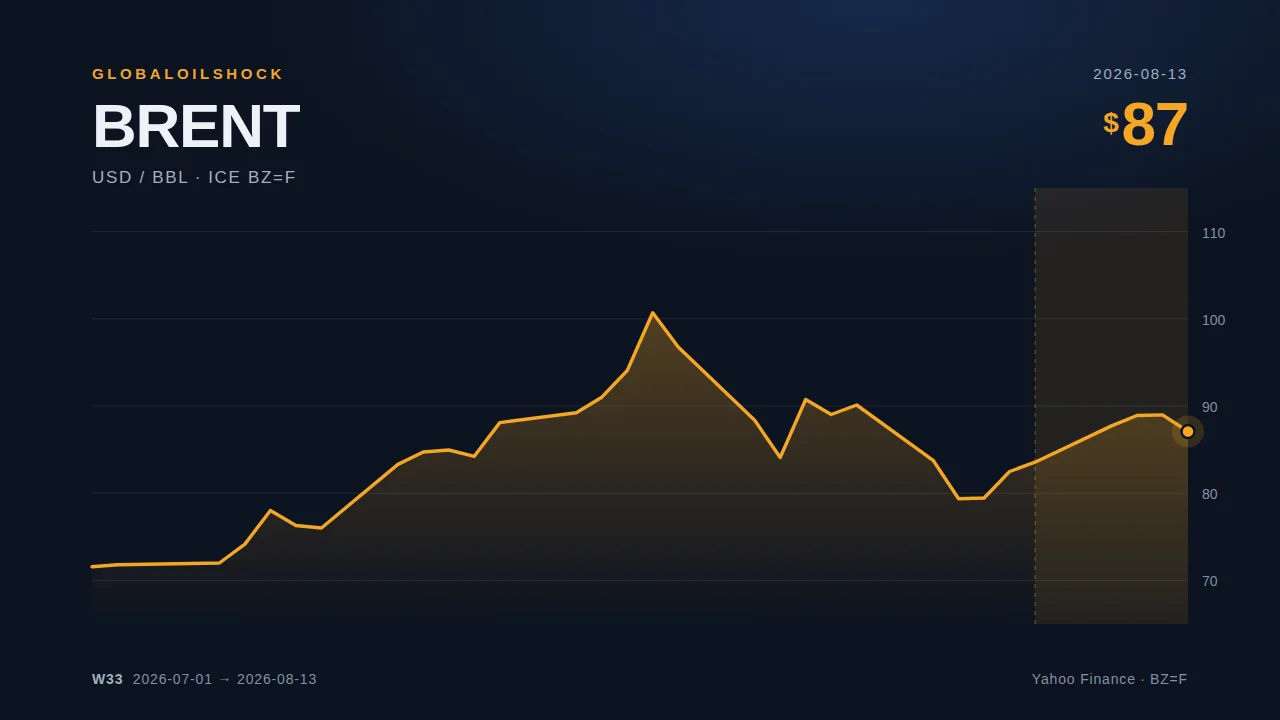
1. What happened this week
On 9 August a crude tanker and a container ship passed the Dardanelles, which meant Turkey had resumed transits into the Black Sea (gCaptain, 9 August 2026). The interruption had lasted three days.
The same day Saudi Arabia reported a fire put out at the Aramco refinery in Jizan without naming a cause. The Houthis stated that they had hit the plant with a drone (Al Jazeera, 9 August 2026).
On 12 August the Houthis attacked a merchant ship in Bab el-Mandeb. Six people lost their lives, according to the Yemeni government (Al Jazeera, 12 August 2026).
On 13 August Shafaq News reported that exports through the pipeline from Kirkuk to the Turkish port of Ceyhan had fallen to around 120,000 to 135,000 barrels a day. In July they had still stood at about 300,000 barrels (Shafaq News, 13 August 2026).
2. Bab el-Mandeb: from damaged steel to lost lives
Up to this day the attacks in the Red Sea had damaged ships and upset schedules. 12 August was the first incident of this summer with dead on board.
For the decisions shipping companies take, that is a different category altogether. Damage to a vessel can be insured and priced in. A danger to the crew reaches into employment law, into the unions and into the question of whether seafarers will sign on for a voyage at all. This is where the pressure builds that makes a route uneconomic long before it is formally closed.
The detour around the Cape of Good Hope stretches the run from the Persian Gulf to Rotterdam from about 19 to about 35 days, according to the U.S. EIA. Those extra days surface later as a mark-up in every litre that arrives in Europe, together with the war risk premium charged for the passage.
3. Kirkuk to Ceyhan: the alternative route becomes a bottleneck itself
The pipeline from the Kirkuk fields to the Turkish Mediterranean port of Ceyhan had taken on a new role in the spring. Once Iraqi loadings in the south at Basra had come to a near standstill, the northern route became the most important remaining exit for Iraqi oil that does not have to pass through the Strait of Hormuz.
The drop to roughly a third of the July level therefore hurts twice over. It takes volume off the market, and it takes it off a route that was meant to be the way around the problem.
According to the report the causes are technical and contractual and do not go back to an attack. That distinction matters: not every disruption of this summer has a military cause, and mixing the two overstates the situation in one place and understates it in another.
4. What this means for households in Europe
On 10 August heating oil in Germany cost EUR 1,315.70 per 1,000 litres, 2.4 percent more than a week earlier. Austria went the other way and fell clearly to EUR 1,542.90 (down 4.5 percent), France to EUR 1,646.20 (down 3.8 percent), while Spain edged up to EUR 1,291.40 (up 1.7 percent). All figures from the EU Oil Bulletin, as of 10 August 2026.
The decline in Austria and France is the delayed echo of the quiet week before. Heating oil prices follow the crude price with a gap of roughly one to two weeks, and that gap runs for different lengths in different countries, because storage and delivery chains are not organised the same way.
On an order of 3,000 litres the difference between the German reading of 3 August and the one of 10 August comes to around EUR 92. The calculator on the home page brings the current values together with your own consumption figures.