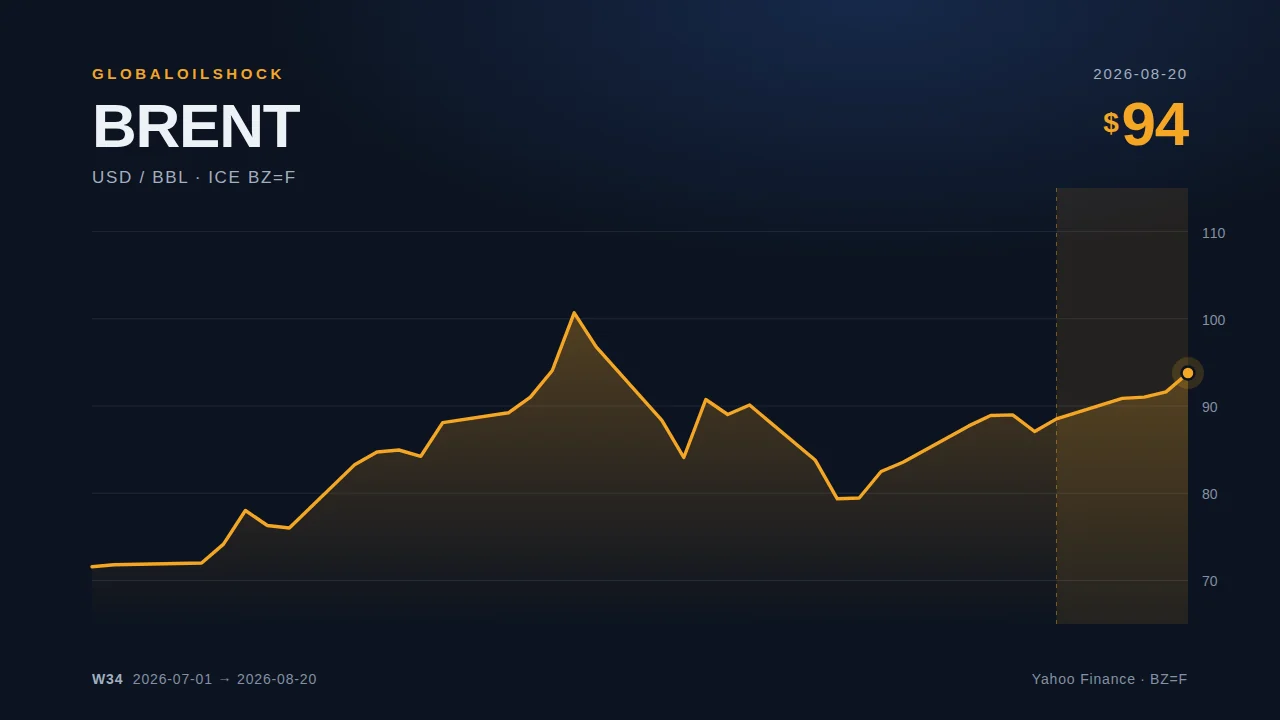
1. What happened this week
The one hard event of these seven days falls on the first of them. On 14 August a Ukrainian drone attack started a fire at the port of Ust-Luga on the Baltic. Alexander Drosdenko, governor of the Leningrad region, said no one had been hurt, and gave no figure for the damage (The Moscow Times, 14 August 2026). The Kyiv Post put the number of drones deployed at 54, and Euromaidan Press counted the strike as the sixth on this port so far this year.
Nothing else was reported as a fresh outage at the chokepoints in the Middle East. The futures contract on Brent nevertheless closed higher on every single trading day: USD 88.52 on 14 August, USD 90.87 on the 17th, USD 91.02 on the 18th, USD 91.62 on the 19th and USD 93.78 on 20 August (Yahoo Finance, BZ=F, daily close).
2. Ust-Luga: why a port on the Baltic moves the price in Europe
The port sits west of Saint Petersburg on the Gulf of Finland. It is one of the most important loading points for Russian crude oil and for the oil products that leave the country across the Baltic.
Only a small share of those volumes still reaches Europe directly. They move the price all the same, because when they fail they are missing as supply on the world market. Oil is a globally traded good: a buyer in Asia who gets less Russian crude buys more from other sources, and there he bids against refineries in Europe.
Then there is the frequency. One fire is an incident, six hits in a year are a condition. For underwriters, and for buyers who sign for deliveries several months ahead, the second reading weighs more than the first.
3. Five days, five steps up: how a trend takes shape
Set this week beside week 29 and the difference between a shock and a trend becomes easy to see. Back then the whole increase arrived on a single trading day. Here it was spread across five of them, in steps of between 0.2 and 2.6 percent.
Movements of that shape come less from single headlines than from the sum of small adjustments: insurance premiums, freight rates, stock levels, rerouted voyages. None of them is news on its own. Together they make supply a little more expensive.
For households this is the less comfortable sort of price movement. A shock is visible, and it is often taken back. A trend stays, and it works its way into the weekly figures for heating oil.
4. What this means for households in Europe
All four countries we follow moved in the same direction this week, for the first time since 6 July. On 17 August a household in Germany paid EUR 1,343.00 per 1,000 litres, 2.1 percent more than a week earlier. Austria went to EUR 1,600.90 (up 3.8 percent), France to EUR 1,696.20 (up 3.0 percent) and Spain to EUR 1,323.30 (up 2.5 percent). All figures from the EU Oil Bulletin, as of 17 August 2026.
That common direction is itself the signal. It suggests the pace is no longer being set by national demand but by the shared price of the raw material.
Measured from the cheapest reading of the summer on 3 August, the German figure now stands 4.5 percent higher. On an order of 3,000 litres that comes to around EUR 173. The weekly figures by country are on our heating oil price map.