1. What happened this week
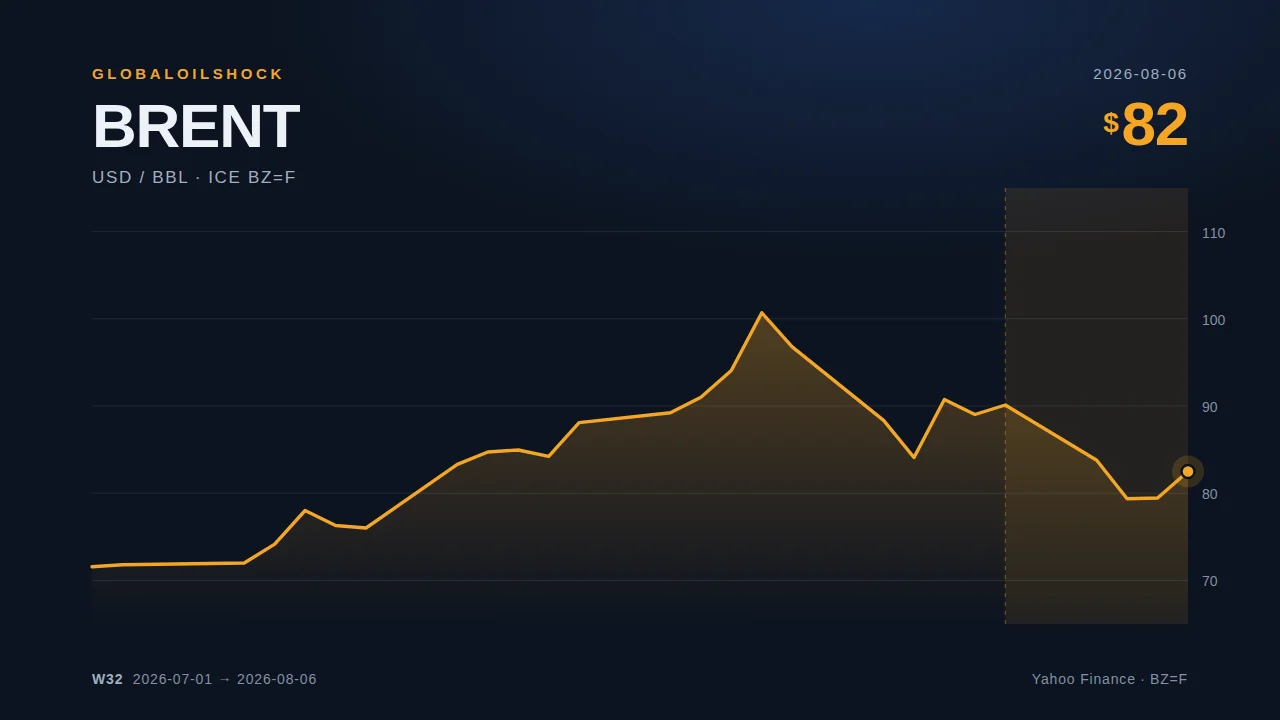
The week opened with a retreat. The futures contract on Brent closed at USD 90.12 on 31 July, at USD 83.77 on 3 August and at USD 79.36 on 4 August. That was the lowest close since 10 July, the day before the declaration of the Revolutionary Guards (Yahoo Finance, BZ=F, daily close).
No fresh outages were reported in these seven days. The CPC terminal on the Black Sea was loading again, the Saudi bypass lines were running, and the Red Sea passed without a reported attack on a merchant ship.
On 6 August the Turkish coastal safety authority stopped issuing transit permits for voyages to Russian and Ukrainian ports for the time being (gCaptain, 9 August 2026). The step affected the way through the Bosphorus and the Dardanelles, which carries a substantial share of Russian and Kazakh oil exports.
2. The oil price: why a quiet week is a cheaper week
Across the week the futures contract slid from USD 89.03 to USD 82.49, a loss of 7.3 percent. What is priced here is what traders think is coming, and seven days without a fresh report of an outage lower the probability of further outages that the market is carrying.
What matters is everything that stayed as it was. The Strait of Hormuz remained closed to free merchant traffic in practice, the US blockade of Iranian ports stayed in force, and so did the Houthi naval blockade against Saudi shipping. The price did not fall because more oil was moving. It fell because nothing was added in seven days.
For households that is the most useful observation of this summer: the quiet weeks are the cheap weeks, and they give no notice that they are coming.
3. Bosphorus and Dardanelles: a permit that suddenly counts
The Turkish straits are not a bottleneck that gets written about much. Their legal footing has been the Montreux Convention since 1936, and merchant ships pass them freely in peacetime.
What happened on 6 August was therefore no interference with the passage itself but with its paperwork: transit permits for certain destinations were no longer being granted for the time being. The trigger, according to the report, was a rising number of attacks on ships in the Black Sea.
It counts for the oil market because Russian crude from Novorossiysk and Kazakh crude from the CPC terminal reach the Mediterranean by this route. Set against the CPC halt from week 30, the picture is of a way out that was interrupted twice inside three weeks without a shot being fired in its direction.
In our monitoring of the shipping routes this point moved to disrupted during the week and back again three days later. Both changes are recorded with their date in our data.
4. Heating oil: the pause that Germany used
On 3 August heating oil in Germany cost EUR 1,285.20 per 1,000 litres, 2.2 percent less than a week earlier. It was the second week of falling prices in a row and, as later became clear, the cheapest level of the whole summer after the closure. Austria moved the other way to EUR 1,615.90 (up 1.4 percent) and France to EUR 1,711.90 (up 1.2 percent), while Spain eased slightly to EUR 1,270.00 (down 0.4 percent). All figures from the EU Oil Bulletin, as of 3 August 2026.
Anyone who ordered in this week bought well, seen from here. That can only be said from here, and the difficulty of every purchase decision sits in exactly that: the cheapest moment becomes recognisable once it has passed. Splitting an order across several dates therefore achieves more than trying to guess the low.
The weekly figures by country sit on our heating oil price map, which also holds the longer series for Germany. How a heating oil price comes together is explained on its own page.