1. What happened this week
On 19 July the Caspian Pipeline Consortium suspended loading at its Black Sea terminal after drones struck two tankers at the mooring buoys (Bloomberg, 19 July 2026). From 21 July the consortium stopped accepting Kazakh oil altogether, and Kazakhstan throttled its production in response (The Moscow Times, 23 July 2026).
A day after that halt, on 20 July, the Houthi spokesman Yahya Saree declared an immediate naval blockade against Saudi shipping. He named no enforcement zone, and vessels under other flags were expressly not covered (Al Jazeera, 20 July 2026).
On 22 July an international naval body reported missiles and drones being used against ships in the southern Red Sea (CNBC, 22 July 2026).
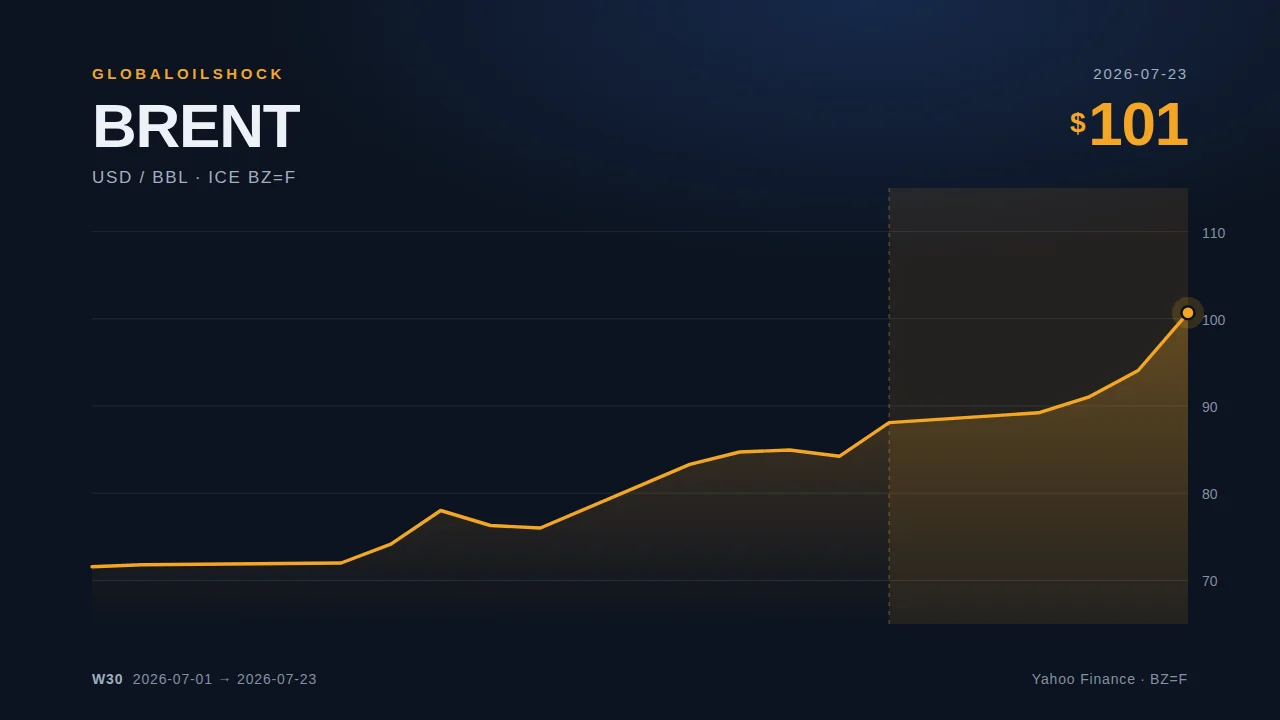
On 23 July the Houthis said they had attacked two Saudi tankers. Brent closed that same day at USD 100.69, 7.0 percent above the previous day (Reuters, 23 July 2026).
2. Black Sea: a second bottleneck joins the first
Until this week the attention was almost entirely on the Persian Gulf. The halt at the CPC terminal changed that, because it hits a route that has nothing to do with the Strait of Hormuz.
The Caspian Pipeline Consortium moves crude oil from Kazakhstan straight across Russia to the Russian Black Sea coast. From there it travels through the Bosphorus into the Mediterranean. When that chain fails, the market loses barrels that never had to pass any of the familiar chokepoints.
Kazakhstan felt it at once and cut production, because the outflow was missing (The Moscow Times, 23 July 2026). Oil that cannot be moved out cannot be pumped either, and storage at the wellhead is finite.
A bottleneck, in other words, is no longer a single place. It is a chain of line, terminal, strait and destination port, and it holds only as well as its weakest link.
3. The oil price: the hundred is back
From USD 84.23 on 16 July to USD 100.69 on 23 July, the futures contract added 19.5 percent in a single week. It got there in steps: USD 88.10 on 17 July, USD 89.22 on 20 July, USD 91.01 on 21 July, USD 94.07 on 22 July, and then the jump over the mark.
The round number carries no economic weight, but it carries public weight. Above one hundred dollars the coverage changes tone, and households begin to bring their orders forward. Part of the move in heating oil prices over the following days comes from exactly that.
What makes this week stand out is the spread of the triggers. Two of them lay outside the Persian Gulf. That is what separates an escalation in one place from a crisis that reaches several routes at once.
4. What households in Europe are paying
On 20 July heating oil in Germany cost EUR 1,339.10 per 1,000 litres, against EUR 1,248.70 a week earlier, an increase of 7.2 percent. Austria stood at EUR 1,538.10 (up 9.0 percent), France at EUR 1,605.30 (up 6.6 percent) and Spain at EUR 1,196.30 (up 7.7 percent). All figures from the EU Oil Bulletin, as of 20 July 2026.
Measured from the reading of 6 July, that makes heating oil in Germany 15.1 percent dearer within two weeks. For a household ordering 3,000 litres the difference comes to around EUR 527.
Anyone weighing up the timing of an order in this situation will find the weekly figures by country on our heating oil price map, which also carries the longer line for Germany.