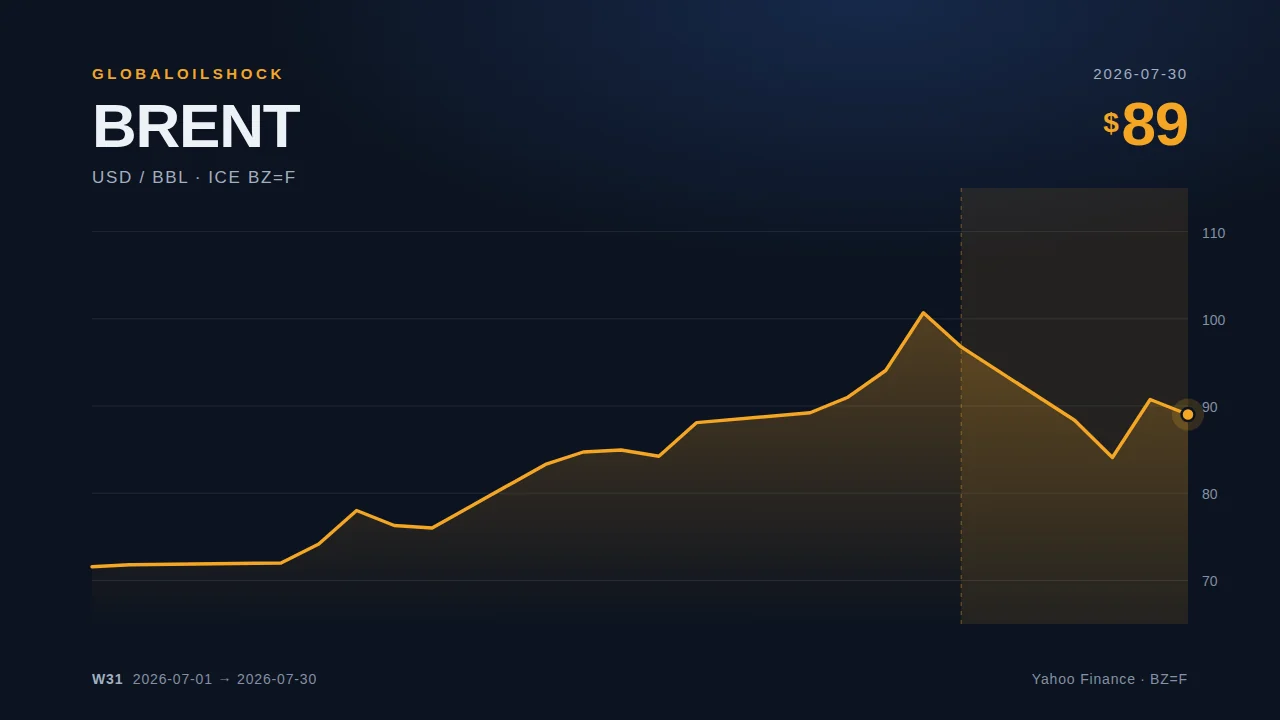
1. What happened this week
On 25 July the Houthis reported missile and drone attacks on Aramco facilities in Jizan and Yanbu. Satellite images showed fires at Jizan, while Riyadh officially confirmed no damage (Türkiye Today, 25 July 2026). That gap between what the attacker claims and what the authorities confirm runs through the whole summer.
On 27 July the Caspian Pipeline Consortium resumed loading at two of its buoys, after a good week of standstill (Times of Central Asia, 2026).
On 29 July a drone struck two gas carriers in the Egyptian Mediterranean port of Damietta, not far from the northern end of the Suez Canal. The United States held Iran responsible, and the Iranian foreign ministry rejected that (Al Jazeera, 29 July 2026; CNBC, 30 July 2026).
On 30 July renewed attacks interrupted loading at the CPC terminal once more, though only briefly.
2. The oil price: why a fall is not an all clear
The futures contract went from USD 100.69 on 23 July to USD 89.03 on 30 July, a loss of 11.6 percent. The low for the week came on 28 July at USD 84.09.
A pullback of that size after a jump is ordinary. Once the feared outage fails to materialise, the buyers who came in on the headline sell again, and the price gives way without anything on the supply routes having improved.
That is precisely what happened here. No route that had been out of service came back in these seven days, and with Damietta a place was added where nobody had reckoned with attacks at all. What gets quoted as the Brent price is a contract for delivery months ahead, so the futures market registers what traders expect, not the condition of the routes themselves.
3. Damietta: the war reaches the eastern Mediterranean
Damietta sits on the Egyptian Mediterranean coast, east of Alexandria and around 70 kilometres west of Port Said, where the Suez Canal meets the sea. The port handles liquefied gas and containers.
Two things make the strike of 29 July remarkable. The place had until then been off every risk map: Egypt is not a party to the war, and the eastern Mediterranean counted as safe water. And the target was gas carriers rather than crude tankers, which pulled the energy Europe uses to fill its storage into the same squeeze.
Responsibility remained contested. Washington named Iran, the Iranian foreign ministry denied it. We therefore carry the incident with both accounts and present neither of them as settled.
4. Four countries, four directions
This week shows neatly why a single national figure says little about Europe. On 27 July a household in Germany paid EUR 1,314.60 per 1,000 litres, 1.8 percent less than a week earlier. Over the same days the price rose in Austria to EUR 1,594.00 (up 3.6 percent), in France to EUR 1,691.70 (up 5.4 percent) and in Spain to EUR 1,274.90 (up 6.6 percent). All figures from the EU Oil Bulletin, as of 27 July 2026.
The reasons sit in the market itself. In Germany the wave of orders from the previous week had been worked through and demand fell back. In France and Spain the rise in the crude price only arrived now, with the usual delay of one to two weeks. Different rates of duty and different haulage costs come on top of that.
Anyone wanting to know how this lands at home will find the figures by country on our heating oil price map, and what a heating oil price is made up of is set out separately. The calculator on the home page brings the current values together with your own consumption.