1. What happened this week
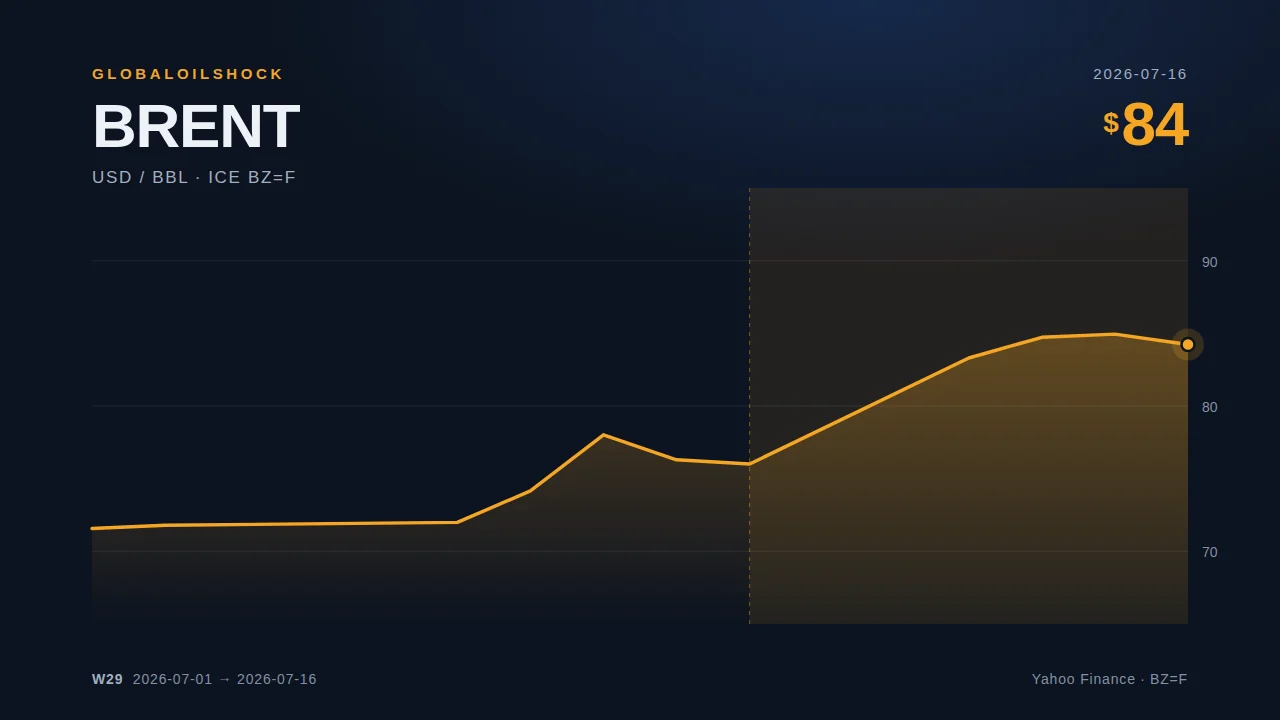
The week starts from a broken ceasefire. The truce brokered in the spring between the United States and Iran had collapsed on 8 July, and two days later the futures contract on Brent still closed at USD 76.01 per barrel (Yahoo Finance, BZ=F, daily close).
That figure did not survive the weekend. On 11 July the naval arm of the Revolutionary Guards declared the Strait of Hormuz closed. Al Jazeera, Axios and Bloomberg all reported it, but the Iranian wording varied: some accounts spoke of a closure for all shipping, others of a warning against passage (Al Jazeera, 11 July 2026).
Trading resumed on 13 July, and Brent closed at USD 83.30, 9.6 percent above the Friday close.
A day later, on 14 July, US Central Command brought its blockade of vessels to and from Iranian ports back into force at 16:00 US Eastern time. Iran responded by declaring the underlying memorandum void (CENTCOM, 13 July 2026).
2. The oil price: a news shock, not a supply shortfall
From USD 76.01 on 10 July to USD 84.23 on 16 July: 10.8 percent in six days, and almost all of it earned on the first trading day after the declaration.
That is what a news shock looks like. The market reprices a risk the moment the headline lands, not at the speed at which barrels actually stop moving. Not a single field went offline in these seven days. What fell was a sentence.
For scale: on 1 July the closing price still stood at USD 71.57. Just over two weeks later it was USD 84.23. How far the spot price and the futures market can drift apart in such a phase became even clearer in the weeks that followed.
3. A closure and a blockade are not the same thing
The two events of this week look alike and work differently. Telling them apart explains why the figures from this period are so hard to pin down.
What Tehran announced on 11 July applies to every ship that wants to transit the strait. It is not a legal order but a statement backed by military means. Whether a vessel sails is settled between the shipping company and its underwriter, and the price of that decision is the war risk premium.
The American measure of 14 July is aimed narrowly at traffic to and from Iranian ports. It bites above all on exports from Kharg Island, the most important loading point in Iran. The rest of the Gulf trade is not directly caught by it, though it is very much caught by the declaration of the Revolutionary Guards.
Together the two turned reliable transit counts into a scarce commodity for weeks afterwards. Ships switch off their transponders in risk areas, so counts based on AIS understate the traffic. We have carried that caveat with every figure on the strait ever since.
4. What this means for households in Europe
The heating oil price moved faster than usual. On 13 July a household in Germany paid EUR 1,248.70 per 1,000 litres, against EUR 1,163.40 a week earlier. Austria went to EUR 1,411.30 (up 8.0 percent), France to EUR 1,505.70 (up 6.0 percent) and Spain to EUR 1,110.70 (up 3.0 percent). All figures from the EU Oil Bulletin, as of 13 July 2026.
The reason for that unusually quick pass through has little to do with what dealers pay for the product. After a headline like the one of 11 July, a great many households order at the same time. Sellers then set their prices against demand as well as against their own purchase costs.
The weekly figures by country are on our heating oil price map, there with a history over 52 weeks. What follows from them for an individual household depends on consumption and on the type of heating.