
Definition: production ceilings per country
OPEC+ quotas are production ceilings that members of the alliance commit to. OPEC has cooperated with other producers through OPEC+ since 2016; the original ten partners are Russia, Azerbaijan, Kazakhstan, Bahrain, Brunei, Malaysia, Mexico, Oman, South Sudan and Sudan (Middle East Institute, 24 November 2025). OPEC itself has 12 member countries (OPEC, 29 April 2026).
Each country has a reference level and a production target derived from it. Ministerial meetings decide cuts or increases, and the JMMC committee monitors implementation. Individual countries can also pledge extra voluntary cuts.
History: from market-share war to alliance
The cooperation began in 2016 after a steep fall in oil prices. The alliance's biggest cut came after the pandemic demand collapse: 9.7 million b/d (Middle East Institute, 24 November 2025). In October 2022 OPEC+ agreed a 2 million b/d cut, and in April 2023 several members announced further voluntary cuts of about 1.15 million b/d from May, including 500,000 b/d from Saudi Arabia (Al Jazeera/Reuters, 2 April 2023).
In 2026 the Gulf war dominates the output figures: the IEA reports that OPEC+ production fell to 33.11 million b/d in August 2026, from 34.57 million in July (Oil Market Report, 11 September 2026).
Mechanics: baseline, cuts, JMMC and compliance
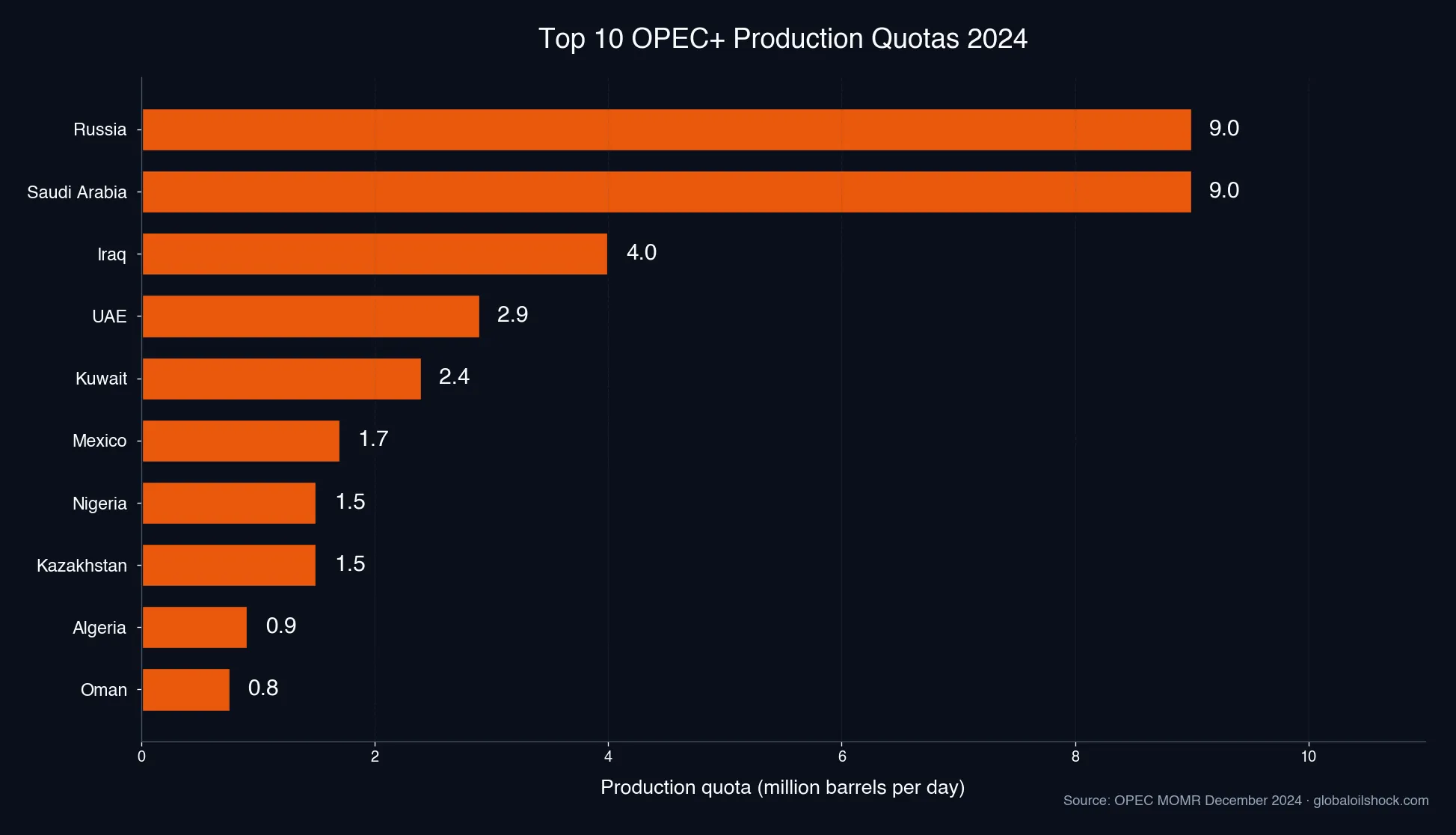
The quota system runs on three levers. First, each country's reference level, from which cuts are calculated; it is often disputed, because every government wants the highest possible base. Second, joint cuts or increases agreed at ministerial meetings. Third, voluntary extra cuts by individual countries, such as Saudi Arabia's additional 1 million b/d from July 2023 (S&P Global, 4 June 2023).
OPEC assesses compliance using independent secondary sources, because countries' own reports can differ. A member that produces more than pledged is supposed to compensate in later months.
Example: Saudi cuts in 2023 and your gasoline bill
After the cuts of spring and summer 2023, Brent averaged 74.84 USD a barrel in June 2023 and 93.72 USD in September 2023 (EIA, Brent spot price). How much of that rise came from OPEC+ and how much from demand, inventories and the dollar cannot be cleanly separated.
For your gasoline and heating-oil bills, cuts work through crude prices and refinery margins, plus taxes and retail margins. In hindsight such a move is easy to read; in advance it cannot be planned.
Implications for the U.S.: shale as the structural counter
According to the EIA (16 April 2025), U.S. crude oil production averaged 13.2 million b/d in 2024. That changes the U.S. exposure to OPEC+ cuts: when OPEC+ cuts, U.S. consumers pay more, while U.S. producers earn more, and the two effects partly offset each other. Prices remain tied to the global Brent benchmark.
Washington has no seat at OPEC+ meetings. Through the International Energy Agency, the United States can take part in coordinated releases from strategic stocks; what was released in 2026 is tracked in our overview of the 2026 IEA release.
Who is affected: drivers, refiners, the Fed
U.S. drivers and trucking companies feel OPEC+ decisions at the pump with a delay. Heating-oil households in the Northeast are directly exposed in winter. Industrial buyers with hedged contracts are insulated short-term but pay the difference at the next renewal.
Gasoline carries a direct weight in the consumer price index, so a sustained Brent rise feeds into headline inflation, which the Federal Reserve has to take into account.