
Coordinated emergency mechanism by which IEA member states jointly release portions of their strategic oil reserves to dampen price spikes after a supply disruption.
The IEA was founded in November 1974 by 16 OECD states and is based in the Paris district of La Défense. Today it has 31 members (28 of them with reserve obligations) and 12 associates. Its core function is the Coordinated Emergency Response: in the event of a defined supply shock, typically a loss of more than 7 percent of global supply over 30 days, the IEA can oblige its members to mobilize part of their emergency reserves.
The mechanism has been activated five times since 1991: Gulf War 1991 (33 million barrels), Hurricane Katrina 2005 (60 million), Libya 2011 (60 million), Ukraine war March 2022 (62 million) and April 2022 (180 million from the U.S. SPR alone, plus 60 million coordinated). Each country holds its reserves either as government stockpiling (Germany: EBV, the national petroleum stockpiling association), as a mandatory industry reserve (France: SAGESS), or as a mixed system (USA: 100 percent state-owned SPR).
History: from the 1974 founding to crisis routine
The IEA emerged directly from the 1973 shock. Henry Kissinger initiated the International Energy Program as the U.S. response to the OPEC embargo; in November 1974, 16 OECD states signed the treaty that established the IEA as an autonomous agency under the OECD umbrella. The core commitments of 1974: members undertake to hold reserves covering at least 60 days of net imports (raised to 90 days in 1980), to exchange data transparently, and to carry out coordinated releases in the event of a crisis.
The first activation came only in 1991, after the Iraq-Kuwait embargo: 2.5 million barrels per day were released by the members over 30 days, 75 million barrels in total, of which about 17 million came from the USA. Hurricane Katrina in 2005 was the first shock to hit a producing country rather than a consuming country: 60 million barrels were released, mostly from the U.S. SPR. The most recent and largest action came in 2022: a 180 million barrel SPR release by the USA over 6 months, plus two coordinated IEA tranches (62 + 60 million barrels), the largest mobilization in history.
Mechanics: tagging, drawdown, tender, how reserves reach the market
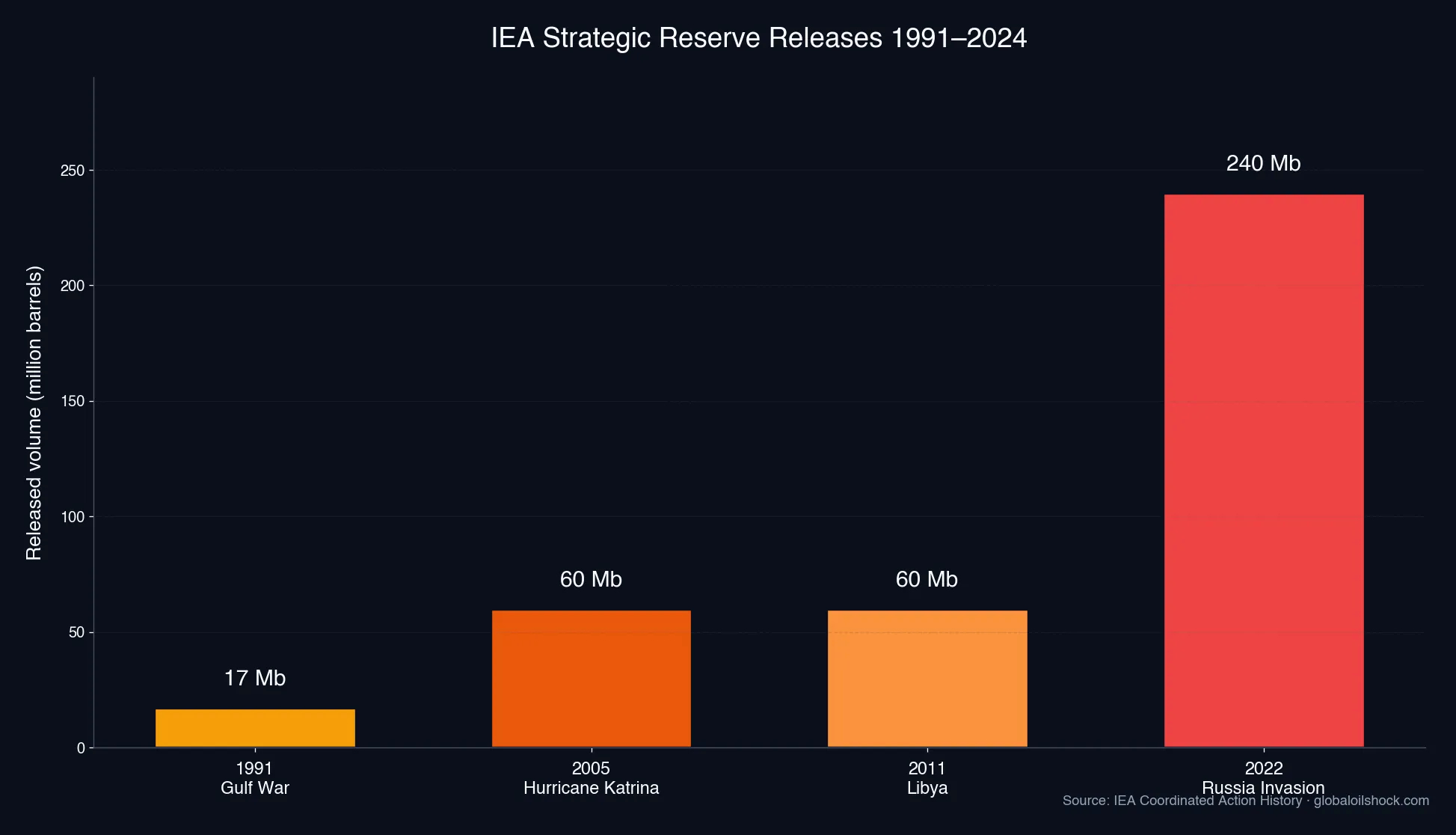
The IEA mechanism has three steps. First, tagging: the IEA declares a supply disruption event, defines the volume and allocates it by member shares. Germany carries about 6–8 percent of every release (proportional to its import volume). Second, the drawdown: each member decides for itself how to mobilize its share, via government tenders (USA, France), industry swaps (Germany's EBV releases stocks from its 70 mandatory storage sites), or obligation reduction (a member temporarily lowers its stockpiling obligation). Third, market injection via public tenders or direct sales to refineries.
The EBV in Germany holds about 24 million barrels of mandatory reserves plus around 40 million barrels of government reserves, spread across 70 storage sites nationwide, mainly salt caverns in Lower Saxony (Etzel, Heide, Ohrensen) and tank farms in Wilhelmshaven. The reserves cover about 90 days of net imports; in the 2022 action, Germany released a proportional share of around 5 million barrels. The volume is small compared with OPEC+ cuts (often 1+ million barrels per day), but the signal is strong: importing countries demonstrate that they can respond to shocks, which takes speculative risk premium out of the market.
Example: What the 2022 releases meant for German heating oil customers
In early March 2022, three weeks after the war began, the IEA announced the first release: 62 million barrels over 30 days, 30 million of it from the U.S. SPR and 32 million from the other 27 members. Brent stood at 130 USD on March 8; a week later, after the announcement, it fell to 105 USD. Not all of that was due to the release, hopes for negotiations were rising at the same time, but around 10–15 USD of the move was attributed to the release in market analyses.
For German heating oil customers this meant: anyone who bought in April 2022 after the first release (around 130 EUR per 100 liters) paid about 15 EUR less per 100 liters than they would have without the release. On a 2,500 liter order that is 375 EUR in savings. The second release (180 million barrels over 6 months from April 2022) pushed the price down further; from July to October heating oil hovered around 105–115 EUR per 100 liters, well below the March peak of 175 EUR. The cumulative effect of the releases for a heating oil household using 2,500 liters per year over 2022 came to around 600–800 EUR in savings.
Implications for Germany: reserve policy becomes more visible
Until 2022, Germany's petroleum stockpiling was largely invisible, a technical agency with 70 storage sites that had been mobilized only three times in the previous 30 years. 2022 changed that: the EBV released reserves publicly, the BMWK communicated the activation in press conferences, and reserve policy became a subject of Bundestag debates.
Structural consequences since 2022: the EBV reserves were increased by about 15 percent (to roughly 27 million barrels of mandatory stocks plus increased government reserves), and the mandatory stockpiling ordinance was modernized (synthetic fuels and biodiesel can now also be counted). Politically, the relationship with the IEA in Paris has deepened: Germany now contributes actively to stress tests and what-if scenarios instead of just waiting for activations. The Federal Network Agency has expanded its oversight of strategic energy infrastructure (pipelines, refineries).
Who is affected: from the pump price to the federal government
In the short term, IEA releases are felt directly only in prices at filling stations and on heating oil deliveries, typically 5–15 USD per barrel less on Brent for 4–8 weeks, which works out to 4–8 cents per liter at the pump. Industrial buyers with hedging contracts benefit indirectly: their hedge roll costs fall. Freight carriers and airlines with fuel clauses save directly. Energy-intensive industries (chemicals, metals) see lower spot market prices.
Politically, the German federal government is a co-actor in every IEA action. The BMWK coordinates the German quota with the EBV, the Federal Network Agency monitors the market impact, and the Federal Chancellery takes part in IEA crisis conferences. Since 2022 the federal government has established an Energy Security Cluster that bundles all reserve-relevant authorities.