
Monday 10am: Brent jumps from 85 to 95 USD. Traders, speculators, refinery managers see it instantly. Brent futures surge, news outlets report. But what happens at your home?
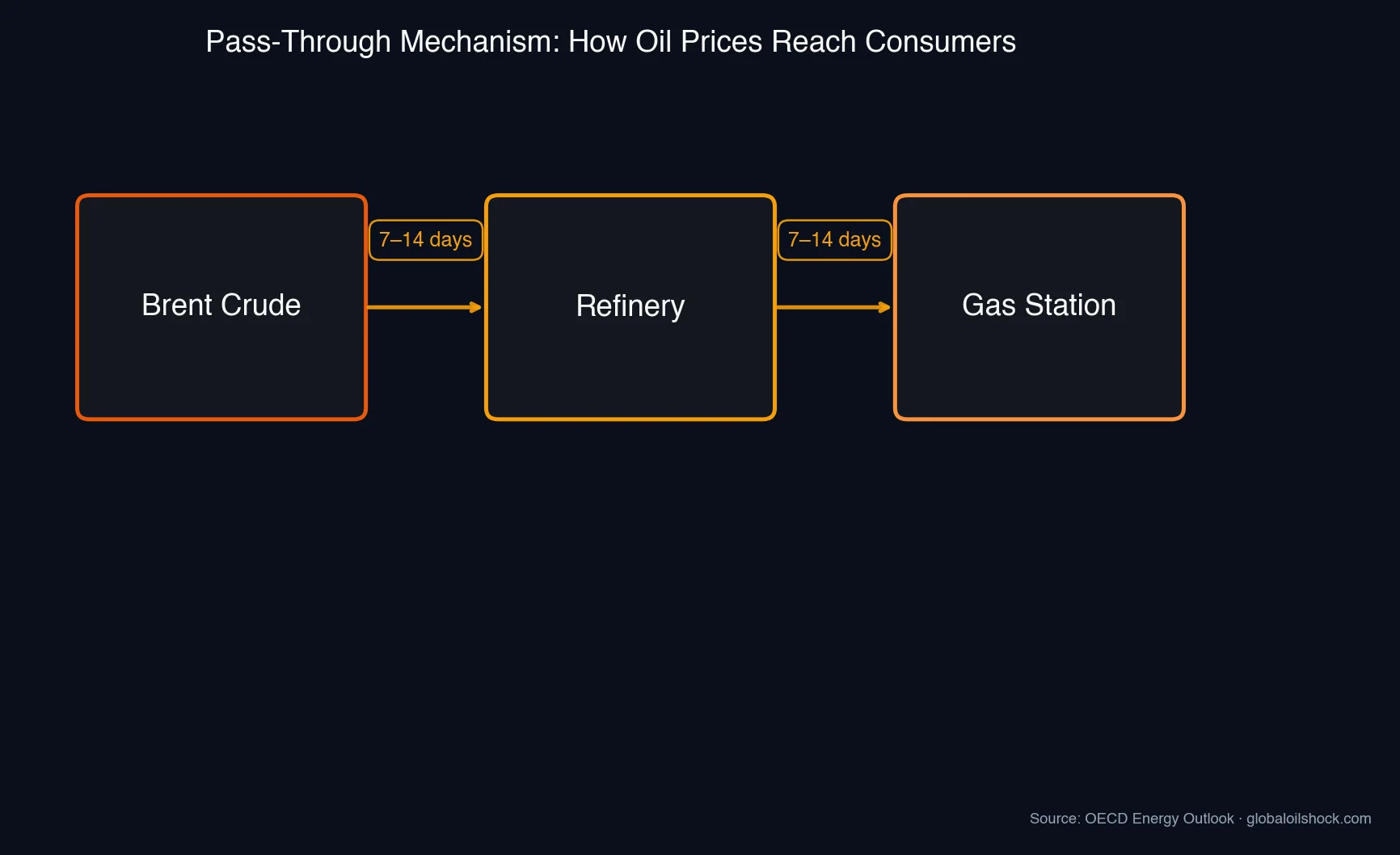
Monday 11am: Refinery managers in Rotterdam recalculate input costs. Heating-oil input prices rise. Monday 3pm: Wholesalers post new prices (partially, not 1:1). Tuesday–Friday: Local heating-oil vendors update quotes, big-volume customers first, then households. Week 1: Early adopters see price changes. Weeks 2–4: Broader customer base receives notices. Weeks 5–6: Laggards (call-price contracts, fixed-term agreements) see full adjustment.
This is the pass-through effect: not lightning, but cascade.
Definition: The path from crude to heating bill
Pass-through means cost transfer across market stages:
- Stage 1 – Crude (Brent): World price, changes every second.
- Stage 2 – Refinery Input: Brent + transport + storage = refinery cost. The lag depends on transport routes and inventories.
- Stage 3 – Heating-Oil Wholesale: Refinery output becomes wholesale price (basis Rotterdam). Wholesale prices follow the Rotterdam quotations.
- Stage 4 – Local Offer: Vendor price-list updates. How often vendors update their price lists varies from dealer to dealer.
- Stage 5 – Household Bill: Your next delivery gets priced at current rate. How long the whole chain takes is not fixed.
This cascade is the pass-through path. Not linear, but filtered through margins, logistics, risk premiums.
Measuring pass-through: Historical correlations
Economists measure pass-through via correlation and regression:
Brent → Heating-oil price (Germany):
- Long-run correlation: 0.88–0.92 (nearly 1:1)
- Pass-through rate: 85–95 percent (5–15 percent absorbed in margins)
- Lag time: not fixed, depends on inventories, the dollar and dealer pricing
- Example: Brent +20 USD a barrel → about 12.6 US cents more per litre of crude, before taxes and margins
Brent → Fuel (Diesel/Gasoline):
- Correlation: 0.75–0.85 (lower than heating oil due to higher tax+margin)
- Pass-through rate: 55–75 percent
- Lag time: depends on competition and station inventories
Brent → Food (indirect via fertilizer+logistics):
- Correlation: 0.4–0.6 (weaker, multiple stages)
- Pass-through rate: 20–40 percent
- Lag time: long, because several processing stages sit in between
How pass-through works, the cascade
Pass-through isn't automatic. Four forces play in:
1. Margin pressure. When crude gets expensive, refiners and dealers often absorb some cost-increase to avoid losing customers. A 10 USD Brent rise doesn't translate to exactly 0.10 EUR/L heating oil, but 0.08–0.09 EUR/L (2–20% margin absorption).
2. Inventory buffers. Large heating-oil dealers hold stock buffers. When Brent rises, they sell from inventory (cheap) and reorder (expensive). This slows pass-through by weeks.
3. Competition. Concentrated markets (Germany: 3–4 major vendors) show faster signals. Fragmented markets (50+ small vendors) show slower pass-through due to information asymmetries.
4. Customer contract mix. Call-price contracts update daily. Fixed-price contracts over months show lag. Market average is a mix.
What pass-through means for your wallet
Scenario 1: Moderate shock (Brent 85 → 105 USD = +20 USD).
- Week 0: Brent jumps. You notice nothing.
- Week 1: Refinery prices rise. Wholesalers list higher. Your vendor sees it but hasn't repriced internally.
- Weeks 2–3: First new heating-oil offers appear (+0.12 EUR/L, about 60% pass-through).
- Weeks 4–6: Mainstream. Your billing gets new prices (+0.18–0.20 EUR/L, 90% pass-through).
- Final impact: 3,000 L heating oil × 0.18 EUR/L = 540 EUR extra/month (consumption-dependent).
Scenario 2: Fast fall (Brent 100 → 70 USD = −30 USD, like 2020).
- Week 0: Brent falls. Expectation: cheaper. Vendors DELAY price cuts (protect margins).
- Weeks 2–4: Slow price reductions, often only 50–70% of the fall. Big customers see it first.
- Week 6+: Price stickiness. Many vendors hold high prices longer than justified (asymmetric pass-through = price stickiness).
- Result: Households benefit less from price drops than they suffer from price rises.
Action: What pass-through means for your order
- Monitor Brent jumps: A sharp Brent jump tells you that dealers' purchase costs are changing, but not when their quotes will follow. A binding quote holds at the price you confirm, whatever Brent does afterwards.
- When Brent falls: price cuts often reach heating oil more slowly than rises (asymmetric pass-through). That does not give you a safe moment to order; compare several quotes and plan by tank level.
- Volatility-dependent lag: In volatile times (Hormuz crisis, OPEC meeting uncertainty) pass-through lag widens because vendors add risk margins.
- Choose distributed vendors: Online platforms (Heizöl.de, Mineraloel.de) update prices faster than incumbent-linked local vendors. Better for timing: you see the next move earlier.